The Way Back to Florence, by Glenn Haybittle
The means to obtain this book The Way Back To Florence, By Glenn Haybittle is quite easy. You could not go for some locations and also spend the time to just find guide The Way Back To Florence, By Glenn Haybittle Actually, you might not always get guide as you agree. But below, only by search as well as locate The Way Back To Florence, By Glenn Haybittle, you could obtain the lists of guides that you really expect. Sometimes, there are many publications that are showed. Those publications of course will certainly amaze you as this The Way Back To Florence, By Glenn Haybittle collection.
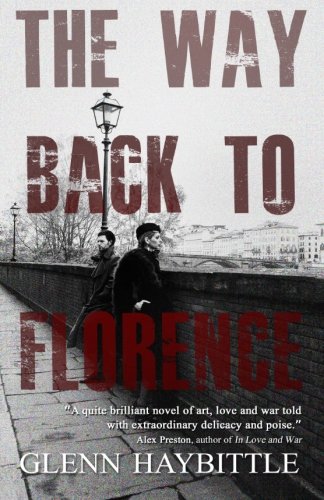
The Way Back to Florence, by Glenn Haybittle

Download PDF Ebook Online The Way Back to Florence, by Glenn Haybittle
In 1937 Freddie (English), Isabella (Italian) and Oskar (a German Jew) become friends at an art school in Florence where they are taught by the dictatorial but magus-like Maestro and his sinister fascist assistant Fosco. When war arrives Freddie returns to England to become the pilot of a Lancaster bomber. Oskar, now a dancer, has moved to Paris where he escapes the 1942 roundup of Jews and arrives in Italy with his young daughter Esme. Isabella remains in Florence where she continues to paint. Until she is called upon by Maestro to forge an old master painting, apparently at the behest of the Führer himself, and as a result is seen as a Nazi collaborator by her neighbours. The murderous skies over Germany and a war-torn Italy in the grip of Nazi occupation provide the setting for this novel about the love of a separated husband and his wife and the love of a man for his young daughter. Freddie and Oskar both hope to find their way back to Florence. But Florence’s heritage of preserving the identity and continuity of the past has never before been so under threat.
The Way Back to Florence, by Glenn Haybittle- Amazon Sales Rank: #997712 in Books
- Published on: 2015-06-24
- Original language: English
- Number of items: 1
- Dimensions: 7.81" h x 1.23" w x 5.06" l, 1.05 pounds
- Binding: Paperback
- 490 pages
About the Author Glenn Haybittle is a translator and freelance writer from London who lives in Florence. He currently translates academic books for the Florence University and Italian history books for a Florentine publisher. The Way Back to Florence is his first novel. He is represented by Annabel Merullo at PFD.

Where to Download The Way Back to Florence, by Glenn Haybittle
Most helpful customer reviews
2 of 2 people found the following review helpful. WW2 in Florence, Italy, art, bomber command By Radek This is an eloquently written and moving WW2 novel set predominantly in Florence, Italy. It focuses on three characters all of whom are forced by the dictates of fascism to forge identity in different ways. One of the novel’s themes is the struggle to preserve identity – as bombs drop and the outward world changes its shape it becomes increasingly difficult for the characters to keep their inner shape. Memory, of course, is the medium of identity and the precarious nature of memory plays a big part in the narrative. “Florence exists to educate our memory,” says one character. War, in this novel, constantly threatens to erase memory. Isabella, a painter and the novel’s central female character, observes while looking at bomb damage – “The ripped open houses with their exposed arrangements, their laid bare secrets, are like portraits. Each one has its own individual facial expression. More identity is on display in the midst of the destruction. More intimacy. It makes her realise how vulnerable these achievements are. Identity. Intimacy.”Her husband Freddie’s sense of self is represented by a portrait of him painted by Isabella and the fate of this painting will mirror in many ways the fate of Freddie himself. Paintings, an emblem of the transcendent power of memory, are often lost or defaced or forged in this novel. Freddie and Isabella meet at a Florentine art school where they study together. They forge their romantic bond during breaks when they go and sit in the nearby English cemetery – not the most auspicious place to put down roots. By 1943 they have become memories to each other. “She steps out of the silver dress and takes a simple black dress from the wardrobe where some of Freddie’s clothes still hang. She tries to remember if Freddie began buttoning his shirt from the top or the bottom. She tries to remember him tying his shoelaces. The images she sees of her husband nowadays are washed out and ghostly as if consisting predominantly of reflected light.” It’s also a novel about displacement and the concurrent yearning for homecoming. War, while ostensibly defending the concept of home, also of course threatens its very existence. The measure of war’s ability to remove all the securities of home is a constant feature of this novel, most chillingly when the narrative takes us to the death camps of Mauthausen and Auschwitz.It begins with Freddie Hartson, a Lancaster bomber pilot, who is told in the briefing hut that tonight’s mission is Florence. Florence, we learn, is where his wife, a painter, lives. The target is not far from the art school where he met Isabella and where his former teacher still works. He has to drop bombs on his own home. Before every operation he has to write a farewell letter to Isabella, his wife, in case he doesn’t return. “When he thinks of his wife now it is like walking barefoot down steps to the sea at night. A secretive act. A moment of wonder he treats with caution as though shielding a buffeted flame.”Life at the station and especially on board the aircraft is vividly evoked, especially the bomb run itself with all its perils and mayhem – “The radar directed flak intensifies. Like swarms of angry red-and-yellow-eyed snakes slithering up invisible ropes in the sky. The sky around them is a glittering maelstrom of light. The stars pale into insignificance. Down below the city is lit up in sections as shockwaves fan out in kaleidoscopic bursts. Shell smoke rising up from the ground. On his right a burst of flame and a thick guttering of black smoke lit up by the geometry of the searchlights.” Provides a moving insight into what those men went through – the dangers of ops over Germany, the fears, but also the moving nature of the fellowship shared by these airmen. There are some memorable scenes too, like when, in thick fog, they nearly land the aircraft on a Luftwaffe base in France, thinking England is below and when they have to crash land in the North Sea. And Freddie has a shaming secret…Isabella is painting when the bombs fall. Later, an SS officer takes a fancy to Isabella at a party and confides that it is his job at present to find two famous paintings that Mussolini has promised to Hitler but that have gone missing. Isabella’s teacher will later persuade her to forge one of these paintings, Pontormo’s portrait of St Anthony, patron saint of lost things. Meanwhile Isabella has had a brief guilty fling with a member of the resistance and has to rely on the SS officer when she is arrested by the sinister Fascist secret police. The tension mounts as she plays a dangerous game.The third central character is Oskar, a friend of Freddie and Isabella’s from their pre-war time together at a Florence art school. He’s a German Jew whose sense of self is bound up in protecting his young daughter. When his wife is caught in the Paris round-up of Jews Oskar manages to escape with his daughter. He makes his way south to Italy but his arrival coincides with the Nazi occupation of Italy. Needless to say, the Gestapo is never far away. The author does a great job of making you fearful for Oskar and Esme.Florence, the city, is the novel’s other major character. We get a beautifully visual portrait of this stunning city. “The sky is a virginal blue translucence as though bereft for a fleeting moment of the effects of both light and darkness. A crimson streak smoulders over the outline of the hills, a simmering bloodline. There is a solitary canoe on the water. A cold white sheen rises from the water. She holds her breath. As if to stop any more time from passing, to stop the future happening. The peacefulness of the morning is almost heartbreaking in its fragility.”There’s also a lot of warmth and wit in this novel, momentum and vitality. It’s written with lots of heart and an imagination at high tide. And we encounter both the kindness and cruelty of strangers in the atmosphere of fear and mistrust that exists in an occupied country. One scene particularly when a woman makes her young son cajole a little Jewish girl into church to see if she crosses herself. The woman has her eye on the reward offered for information on fugitive Jews.Architecturally it plays safe. Emphasis is on storytelling – following a straightforward flight plan, rather like the flight plans of the Lancasters themselves when they set off on an operation. It’s not a novel of versatile innovation or structural sleights of hand. It abides by its limits and as a result is a thoroughly engaging novel pulsing with moments of high tension, poignant sadness and life affirming beauty which also at times illuminates some of the more shrouded areas of human motive.
1 of 1 people found the following review helpful. A ravishing WW2 page turner. By Amazon Customer Once I got into this novel, which didn't take long, I simply couldn’t put it down and I have to confess the ending brought tears to my eyes. I’d never heard of it until a friend here on Goodreads gave it a gushing review and my interest was piqued.The scope of this novel is hugely impressive. We are taken on bombing raids to Berlin, into the world of art theft in Florence, to partisan battles in the hills of Tuscany, to the offices of the secret police in Florence, to Italian internment camps and to the Nazi death camps. And yet for all the pervasive horror of war this is essentially an uplifting novel written with sustained imaginative vitality about how people touch each other and how humanity prevails.We see WW2 through three perspectives – these are three friends who met at art college in Florence before the war. Freddie becomes the pilot of a Lancaster bomber, Isabella, his Italian wife, is a painter in Florence and Oskar, a German Jew, is trying to avoid the Gestapo in Italy. All three narratives are utterly compelling in their different ways. Isabella is dragged into the world of art forgery and the fascist/partisan conflict; Oskar and his young daughter are hunted by the Nazis and have to depend on the kindness of strangers and are constantly in fear of their treachery (huge rewards were offered for information leading to the arrest of Jews). And Freddie is just trying to stay alive - the account of life in Bomber Command is a brilliant feat of imagination – a succession of thrilling set pieces in which you feel you’re up there in the plane. The control of the suspense throughout is done with great skill. You genuinely worry for the safety of the characters. Oskar’s efforts to keep his daughter safe is a very moving account of the love of a father for his daughter, just as Freddie and Isabella’s story is a moving depiction of the love between a separated husband and wife. It’s also a brilliant portrait of Italy and in particular Florence itself. I didn’t want it to end. Fully recommended. Along with All the Light We Cannot See my favourite read of 2015.
1 of 1 people found the following review helpful. A compelling portrait of wartime Florence - finely observed and elegantly constructed - recommended to all Italophiles By Louise This novel opens in September 1943, as allied bombers target Florence:'The air raid siren begins shrieking and before long she hears the now familiar low drone of planes in the sky. The grumbling noise gains in intensity. It becomes a sensation in the body, an irritation on the skin, like a feeding insect. The window frames rattle. All the jars of primers and pigments and sun-thickened oils on the tables and shelves jingle. Circles shiver on the surface of the balsam in the pot on her palette. She goes to the window. Lifts the black drape that keeps out the reflected glare of sunlight. She tilts up her head as if to receive the gentle splash of rain on her face. Never have the planes been this low in the sky before. The metallic insect drone becomes a skip in her heartbeat. The remorseless roar grows more encompassing. Everything she thought of as solid vibrates with its own vulnerability.'Isabella is an artist in the Nazi-occupied city; Freddie, her husband and former fellow art student, has returned to England and is now piloting a Lancaster bomber; Oskar, friend of Isabella and Freddie and a German Jew, has got out of Paris with his daughter and is travelling back to Italy; Marina, Isabella’s sometimes model, has been forced to take a job as a servant in the house of a Fascist; and her friend Francesco, also Jewish, has just had to flee his family home. We meet these linked characters as the allied bombs fall on Florence and follow them through the bloody and destructive period of the Nazi withdrawal.Freddie and Oskar both hope to get back to Florence and yet it's presently a city full of trip wires. A sense of perilousness comes off the page; this novel really brings home the precariousness of living in this time and in this place. People are peering through keyholes. Everyone is watching and being watched. No-one can quite be trusted. As reader we're not quite sure who to trust. The trip wires are everywhere.With chapters narrated from the perspective of each of the characters, this novel is ambitious in its structure. It's a big cast list and I was impressed by how so many threads could be compellingly woven together. It's some fierce feat of architecture and engineering, but for me it never once creaked. Each character's strand has elements of individuality in its telling. Isabella's chapters are full of painterly observation, heightened colour, plays of light and the workroom smells of sun-thickened oils and glues and turpentine. Freddie's chapters are narrated with a more fragmented voice and a tone of melancholy behind the airbase banter. There's some fantastically vivid writing in these sections (the descriptions of the aerial pyrotechnics are, weirdly, extremely beautiful – like a series of abstract paintings) and also a pulse-quickening sense that Freddie's narrative might terminate at any moment. Though a huge amount of research has obviously been invested in these sections, it doesn't weigh them down at all. On the contrary, there's a real sense of in-the-moment to them and I was plunging through the skies with V Victor. The precariousness of the pilot's life – those stacked odds – comes over powerfully. While Freddie is flying over Florence, Isabella too is precariously occupied below: working on a portrait of a Nazi officer and, under instruction, forging a copy of an old-master painting of Saint Anthony (patron saint of lost things). It is almost three years since she has heard from Freddie. She sends letters, but gets no replies. She doesn't know if he is lost too.'She tries to remember if Freddie began buttoning his shirt from the top or the bottom. She tries to remember him tying his shoelaces. The images she sees of her husband nowadays are washed out and ghostly as if consisting predominantly of reflected light.'The interweaving narratives enhance one another. Freddie exposes Isabella's vulnerabilities and thus draws out our sympathy. For his sake, I wanted her to make it through; for hers, it mattered that Freddie kept on making it back to base. In part I wanted the arc to conclude with the two of them tidily reunited, but it was more interesting that I wasn't certain that that was going to be - or ought to be - the case.The city of Florence itself, so immediate in this writing, is also a character here. The strong sense of place brings the narrative up close and makes it matter. We hear and smell Florence, we feel the ground quake and are there in the smoke and the dust. Florence is a place of timeless beauty and suddenly danger; there is reassurance in its old stones and yet there is potential betrayal everywhere. The writing compellingly tumbles all of that together.'In Piazza d’Azeglio, Isabella kicks through the fallen ankle-deep leaves of the high sycamore trees. Children used to play here before the war. Now the large square is used to grow corn and cabbages. A fascist militia with a light machine gun hanging from his shoulder stands guard over the cabbages. He looks at her with stern defiance, as though daring her to ridicule the role he has been assigned in the war. Corn and cabbages. It is another example of the comic ineptness of the measures taken by the fascists to prepare for war. She remembers in 1940 when the city’s population had been called upon to donate all the metal objects they could spare. Married women were asked for their wedding rings. Florence’s piazzas were thus heaped with enormous piles of tarnished rusting metal objects. She had thought that if her country was in need of this heap of junk to fight a war then it was a war it would surely lose. There was something almost touching about the slapdash poverty of the contribution. Candelabras, door handles, pipes, bits of engines, tools –how much rubbish there was in the world! It later occurred to her that these bits of waste metal would in all probability be melted down and fashioned into weapons, ammunition maybe. That the candelabra she was looking at might end up lodged in someone’s chest in the form of a bullet, someone who would never know that a household ornament of mysterious provenance would cause his death.'The old stones of Florence seem eternal - and yet are suddenly so fragile. Bridges fall. Certainties are tested. And yet some things go on. The image of the city's sentinel cypresses reoccurs and is one that will stick with me. There's such a wonderful immediacy in this description as Isabella recalls walking through the English cemetery with Freddie in 1937:'She inhales the peppery warm breath of the cypresses. She loves their scent. It’s a scent that seems to make moments memories even before they've stopped happening.'(If ever you could smell a sentence!) In July 1944, just released from prison, she's drawn back there again. So much is the same; so much is irreversibly changed.'She walks away. Feeling the absence of any bag slung over her shoulder. The absence of any keys in her possession. She walks until she is standing opposite the English cemetery. High on its walled island of cypresses. She has the world to herself. There is a sense in the early morning stillness that everything might be begun from scratch. It is another of nature’s deceptions.'This novel is crammed with gorgeously sharp-focused descriptions and images that I'll remember. It's the strength of the writing, the up-close attention to detail, that drags this wartime city so urgently into the here and now. The author really puts his head under the water (as it were) – and pulls us under with him.This is a novel about the precariousness and the preciousness of life. It left me with a sense of how, while the bridges might fall, there are fundamental bonds that endure. Oskar's chapters are particularly moving in that regard and provided some of the high points of the book for me – full of father-daughter tenderness and the kindness of strangers; these small acts of gentleness and generosity seeming so important and powerful at this time. Whilst steering clear of sentimentality, hope and positivity radiate from these scenes. That’s the overall feeling that this novel left me with.This is a big book, an ambitious, grown-up novel and one that properly warrants that sometimes-misapplied word 'epic'. Bold in its scope, impressive in its structure, lovely in its descriptive artistry, I both admired and thoroughly enjoyed it. I enthusiastically recommend this novel to all Italophiles, fans of hist fic and anyone who smiles at a beautiful sentence.
See all 4 customer reviews... The Way Back to Florence, by Glenn HaybittleThe Way Back to Florence, by Glenn Haybittle PDF
The Way Back to Florence, by Glenn Haybittle iBooks
The Way Back to Florence, by Glenn Haybittle ePub
The Way Back to Florence, by Glenn Haybittle rtf
The Way Back to Florence, by Glenn Haybittle AZW
The Way Back to Florence, by Glenn Haybittle Kindle

Tidak ada komentar:
Posting Komentar