What Is Visible: A Novel, by Kimberly Elkins
The What Is Visible: A Novel, By Kimberly Elkins oftens be terrific reading book that is understandable. This is why this book What Is Visible: A Novel, By Kimberly Elkins comes to be a preferred book to check out. Why don't you want turned into one of them? You could appreciate reading What Is Visible: A Novel, By Kimberly Elkins while doing other tasks. The presence of the soft data of this book What Is Visible: A Novel, By Kimberly Elkins is type of obtaining experience conveniently. It includes exactly how you ought to conserve the book What Is Visible: A Novel, By Kimberly Elkins, not in shelves naturally. You could wait in your computer system tool and also device.
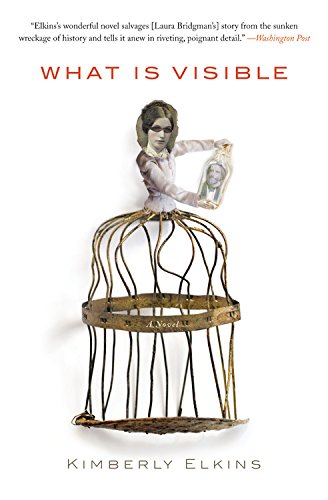
What Is Visible: A Novel, by Kimberly Elkins

Free PDF Ebook What Is Visible: A Novel, by Kimberly Elkins
New York Times Book Review Editors' Choice Bookpage Best Books of 2014 Woman's Day "Most Inspirational Book of 2014" Women's National Book Association Great Group Reads Pick for 2014A vividly original literary novel based on the astounding true-life story of Laura Bridgman, the first deaf and blind person who learned language and blazed a trail for Helen Keller. At age two, Laura Bridgman lost four of her five senses to scarlet fever. At age seven, she was taken to Perkins Institute in Boston to determine if a child so terribly afflicted could be taught. At age twelve, Charles Dickens declared her his prime interest for visiting America. And by age twenty, she was considered the nineteenth century's second most famous woman, having mastered language and charmed the world with her brilliance. Not since The Diving Bell and the Butterfly has a book proven so profoundly moving in illuminating the challenges of living in a completely unique inner world. With Laura-by turns mischievous, temperamental, and witty-as the book's primary narrator, the fascinating kaleidoscope of characters includes the founder of Perkins Institute, Samuel Gridley Howe, with whom she was in love; his wife, the glamorous Julia Ward Howe, a renowned writer, abolitionist, and suffragist; Laura's beloved teacher, who married a missionary and died insane from syphilis; an Irish orphan with whom Laura had a tumultuous affair; Annie Sullivan; and even the young Helen Keller. Deeply enthralling and rich with lyricism, WHAT IS VISIBLE chronicles the breathtaking experiment that Laura Bridgman embodied and its links to the great social, philosophical, theological, and educational changes rocking Victorian America. Given Laura's worldwide fame in the nineteenth century, it is astonishing that she has been virtually erased from history. WHAT IS VISIBLE will set the record straight.
What Is Visible: A Novel, by Kimberly Elkins- Amazon Sales Rank: #339761 in Books
- Brand: Elkins, Kimberly
- Published on: 2015-06-16
- Released on: 2015-06-16
- Original language: English
- Number of items: 1
- Dimensions: 8.13" h x 1.00" w x 5.25" l, .0 pounds
- Binding: Paperback
- 336 pages
From Booklist In this fictional treatment of the life of Laura Bridgman, the first deaf and blind person to learn language, Elkins aims to show “how little one can possess of what we think it means to be human while still possessing full humanity.” After a raging bout of scarlet fever at the age of two, Laura loses her eyes, her hearing, and her ability to taste and smell. Taken from her family home by Dr. Samuel Howe and taught to communicate via hand spelling, Laura soon becomes a celebrated figure attracting hundreds to exhibitions at Howe’s Perkins Institution, including Charles Dickens and Dorothea Dix. But Howe has his own agenda, using Laura to push both the causes of phrenology and anti-Calvinism. When Laura embraces the Baptist faith, she loses Howe’s favor but never loses her fire. Told in alternating chapters by Laura, Howe, his poet wife, and Laura’s beloved teacher, this is a complex, multilayered portrait of a woman who longed to communicate and to love and be loved. Elkins fully captures her difficult nature and her relentless pursuit of connection. --Joanne Wilkinson
Review "I know firsthand how brutally difficult it is to write a creatively rich, humanly revealing novel based on real people in a distant time. Kimberly Elkins does this brilliantly. WHAT IS VISIBLE is not only a compelling, deeply moving novel, it is a fully realized work of art. This is an auspicious debut of an important new writer."―Robert Olen Butler, Pulitzer Prize-winning author of A Good Scent from a Strange Mountain"WHAT IS VISIBLE is remarkable at many levels. It is written in an intelligent, intricate style, populated with many true historical figures, and teeming with convincing period details. Above all, the novel has a unique narrative structure, which illustrates the art of fiction at its best in presenting the interior. A splendid debut indeed."―Ha Jin, National Book Award Winner for Waiting"An astonishing debut that vividly brings to life a forgotten chapter of American history. You'll recognize many of the characters in WHAT IS VISIBLE, but its heroine, Laura Bridgman, is likely someone you've never heard of. After you read it, you'll never forget her. Beautiful, heart-wrenching, and at times quite funny, this book is a marvel."―J. Courtney Sullivan, New York Times bestselling author of Maine and The Engagements"I found myself slowly mesmerized by WHAT IS VISIBLE, and then increasingly haunted and bound to the story of Laura Bridgman, the second, deeper, darker invisibility of her life so permanently excavated and restored to memory by the talented hand of Kimberly Elkins and her extraordinary powers of imagination. To say that I was profoundly moved by this novel would be an understatement."―Bob Shacochis, author of The Woman Who Lost Her Soul"A wonderfully imaginative and scrupulously researched debut novel... [The protagonist] comes across as a willful, mysterious marvel, showing 'how little one can posses of what we think it means to be human while still possessing full humanity.'"―Publishers Weekly (STARRED)"An affecting portrait which finally provides its idiosyncratic heroine with a worthy voice."―Kirkus Reviews
About the Author Kimberly Elkins was a finalist for the National Magazine Award and has published fiction and nonfiction in the Atlantic, Best New American Voices, Iowa Review, Chicago Tribune, Glamour, and Village Voice, among others. WHAT IS VISIBLE is her first novel.

Where to Download What Is Visible: A Novel, by Kimberly Elkins
Most helpful customer reviews
11 of 13 people found the following review helpful. What it feels like to be alive By Andrew Hollweck How do I like this book, let me count the ways. Told largely from the perspective of an historically real, blind deaf-mute woman in the 19th century - Laura Bridgeman - What Is Visible is a fictional impression of Bridgeman's factually rich life story.Elkins manages somehow to offer a character in Bridgeman who is scary - she's hit the trifecta of human misery - completely cut off sensorily from the other children and staff in the home for the blind who populate her world. She's state-of-nature, grunting, groaning and screaming. She rages. But somehow, like any well-written protagonist, we identify with her stumbling and incoherence; we see ourselves in her. This is us, metaphorically shouting mutely, seeing nothing, hearing silence, when everything is aroar; when we long so desperately to connect to our fellow humans, even when our own senses confound us, defy us to do so. Disconnected, locked inside our pathetic coils. The reason Bridgeman can't connect with people is not because she's blind. The brilliance of Elkins's storytelling is to turn Laura's deficits, her uniqueness, into universals: Left without light and sound, her blindness only intensifies Laura's realization that she can't truly understand other people. Her deficits are her assets. She sees people as they truly are. There are no eyes and ears to filter out people's true nature.For a moment, in Elkins's telling, Bridgeman overcomes the impossible physical barriers that separate her from everyone else; she even falls in love and learns to think like a good Victorian. We watch a revolution, from our introduction to her as an unruly little girl to her lesbian romance with her Irish caretaker, and a stilted, unrequited passion for her mentor, Dr. Samuel Gridley Howe, who lifted her out from an isolated home somewhere in New Hampshire. This first love is ultimately unrequited, the second love is intellectualized, both far from perfect. Her abandonment by the caretaker is full of the rush of first romance - who hasn't loved and lost? With Howe she is unable to fully realize his standards for behavior, and, by extension, humanity, he seeks for her, again, not because she is blind, but because she is her own person, because his standards are rules. Howe is kind of a jerk. He's a moralist. Although he tries, he's unable to reach out to Laura because of his limitations, not hers.Bridgeman, so alone, realizes that her instructors, the other girls in the school, her caretakers, all of them, just don't respond to her wails - she is portrayed as so tactile, touching things, always touching - her fingering, her grunts, her delirious expressions of joy and sadness, they make others uncomfortable. Her frailties don't freak them out; her passion freaks them out. Precisely, to my mind, what separate all of us in ways vast and small, from every other person. We hide such passionate expression, this actual reaching out, grabbing actually, for fear of similar rejection. Her story is ours. It's really quite ingenious.The storytelling is extremely tight, the prose creative and largely immaculate. So, reading for reading's sake, you will get your money's worth. What's triumphant is that you close the book thinking, yeah, Bridgeman probably could have, perhaps even did, feel and think these things. Like I think and feel. What's more I disagree with Barbara Kingsolver's Sunday Times review, which nitpicked that the story missed the consequential moment it dawned on Bridgeman that she in fact could communicate by signing into the palms of others. What was that monumental moment like for her, Kingsolver wondered? That's quite missing the point of this story - that may actually have been only the dawn of the time that she realized true communication is difficult, if not impossible.Every time I read a truly great 19th century novel, Middlemarch, Jude the Obscure, I am reaffirmed because I know that we as humans, our emotional life, our needs as sentient animals changes but little. Elkins tweaks this connection; instead of requiring you and I to step into the shoes of our predecessors, she faithfully modernizes them to show us that Bridgeman, 19th century deaf dumb and blind Bridgeman is us. And oh how she roars.
7 of 8 people found the following review helpful. What is Internal By JGrace [i]“Without someone always beside her to translate the world and its comings and goings, she was utterly alone, in a vacuum, at the mercy of those who happened into her palm, or not.”[/i]Before Helen Keller learned to sign ,[i]’water’[/i] into Anne Sullivan’s hand, there was Laura Bridgman. Laura was the first deaf/blind student to be successfully educated in the United States. Her education and her celebrity were managed by Dr. Samuel Gridley Howe, the director of the Perkins Institute for the Blind. This novel is told from multiple perspectives, beginning with the internal, conversational, thoughts of Laura. Chapters are also devoted to Dr. Howe, his famous wife, Julia Ward Howe and Laura’s teacher, Sarah Wight.Laura Bridgman was a very famous 19th century personality. She conversed with many famous people, including Charles Dickens, Longfellow and Dorothea Dix. Her successful education helped to establish Samuel Howe as an influential reformer and educator. She was an early ‘poster child’ for the disabled and was expected to display her skills for large audiences to raise funds for the Perkins Institution. Elkins tells a plausible story of Laura’s distorted perceptions of the world, her obsessive attraction to Samuel Howe, and her destructive self-stimulatory behaviors. Alternate chapters follow Julia Ward Howe’s dissatisfaction with her oppressive marriage and Samuel Howe’s frustrated inability to control neither his wife nor his student.I’m sure Elkins had historically sound reasons for the thoughts and behaviors the she gave her historical characters. There was nothing essentially inaccurate about this fictional retelling. But, I felt that Elkins injected a 21st century political correctness onto her depiction of Samuel Gridley Howe. I have no doubt that the man was insufferably paternalistic both publically and privately. He was a product of his times. That aspect of his personality comes across in this novel, but there his little attention paid to his very real contributions to the education of disabled children. For example, Elkins makes casual mention of the physical fitness and free movement of the blind students at the institute, but spends much time on Howe’s fascination in the science of phrenology (head bumps).Elkins seemed more interested in the homo-erotic overtones of Howe’s relationship with Senator Charles Sumner. In fact, the book is very concerned with the sexual lives of the famous characters, including Sarah Wight’s marriage to a syphilitic missionary. It’s not that the sex lives of the famous is uninteresting, I just find Charles Sumner’s abolitionist speeches and his attack on the Senate floor to be more interesting than speculation on his sexual orientation. Elkins’ book skims over the social and political climate mid-19th century America and keeps it’s focus on the intimate lives of these influential people.
2 of 2 people found the following review helpful. Historical Fiction at its Best By rhten One is always reluctant to use the words "perfect novel," but I can't help myself in this case. Kimberly Elkins has written the very best kind of historical fiction: Without ever seeming to labor under the need to instruct, What Is Visible teaches us to reread this era in our national history. At the heart of debates about religion, education, phrenology, slavery, gender roles, is this remarkable woman, Laura Bridgman, who is both exotically other and so like oneself. I'm a twenty-first century male with reasonably good eyesight and more of my hearing intact than my head of hair, and yet Elkins made it impossible not to identify fully with this young nineteenth century woman deprived of all but one of her senses. What a remarkable accomplishment! Maybe the common link is Laura's never-long-satisfied craving for intimacy—which surely we all know, at least at some period of our sojourns on this planet. What Scorsese did with Countess Olenska's briefly exposed ankle while filming Wharton's The Age of Innocence, Elkins has done with Laura's craving for fingers tapping upon her palm. Laura’s voracious hunger for love, her desperate and unrelenting urge to escape the prison of the self, Elkins has made painfully palpable, concentrating our attention upon the small patch of flesh that becomes a new erogenous zone. The reader is so relieved to recognize so poignantly this urge in another person. By witnessing Laura's isolation so completely, we are able to escape for a while our own. For that reason, more than any other, I was very sorry when the book was over. Elkins places Laura Bridgman at the center of a larger and ever expanding canvas—exploring the lives of other characters central to the period: Charles Sumner, John Brown and the Secret Six, Dickens, Dickinson, Annie Sullivan. Two of the most fascinating characters are Julia Ward Howe and Laura's nurse Sarah, two women who work hard to define themselves within the confines of their respective marriages. In the hands of Elkins, Julia Ward Howe (a poet best remembered for penning “The Battle Hymn of the Republic”) begins as a spoiled debutante but goes on to take up the banner of women's rights. Another aspect of WHAT IS VISIBLE that amazes is its language: page after page, it is densely lyrical without ever succumbing to the florid excesses one often encounters in nineteenth century prose. Elkins has captured the essence of their language while successfully updating it for the ear of a contemporary reader. It's a symphonic novel, rich with distinctive voices singing contrapuntally, their music overlapping, and struggling for harmony but never willing to sacrifice their own integrity.
See all 53 customer reviews... What Is Visible: A Novel, by Kimberly ElkinsWhat Is Visible: A Novel, by Kimberly Elkins PDF
What Is Visible: A Novel, by Kimberly Elkins iBooks
What Is Visible: A Novel, by Kimberly Elkins ePub
What Is Visible: A Novel, by Kimberly Elkins rtf
What Is Visible: A Novel, by Kimberly Elkins AZW
What Is Visible: A Novel, by Kimberly Elkins Kindle

Tidak ada komentar:
Posting Komentar