Tigerman, by Nick Harkaway
Tigerman, By Nick Harkaway. Exactly what are you doing when having leisure? Talking or searching? Why do not you try to review some book? Why should be checking out? Checking out is among fun and pleasurable activity to do in your leisure. By reading from many sources, you can find new details and also encounter. Guides Tigerman, By Nick Harkaway to check out will be many beginning with clinical e-books to the fiction e-books. It implies that you can check out the publications based upon the requirement that you want to take. Naturally, it will certainly be different and also you can check out all e-book types any time. As below, we will show you an e-book should be checked out. This book Tigerman, By Nick Harkaway is the option.
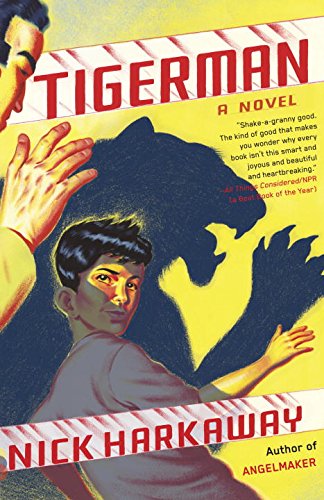
Tigerman, by Nick Harkaway

PDF Ebook Download : Tigerman, by Nick Harkaway
A KIRKUS REVIEWS and NPR BEST BOOK OF THE YEAR A WASHINGTON POST AND ALA NOTABLE BOOK From the award-winning author of Angelmaker, Tigerman is a novel at once heartfelt and thrilling—about parenthood, friendship and secret identities, about heroes of both the super and the everyday kind. Sergeant Lester Ferris is a good man in need of a rest. After a long career of being shot at, he's about to retire. The mildly larcenous, backwater island of Mancreu, a former British colony in legal limbo, belching toxic clouds of waste and facing imminent destruction by an international community afraid for their own safety, is the ideal place to serve out his time. There is an illicit Black Fleet lurking in the bay: spy stations, arms dealers, offshore hospitals, drug factories and torture centers. Lester's brief, however, is to sit tight and turn a blind eye, so he drinks tea and befriends a brilliant, Internet-addled street kid with a comic-book fixation. When Mancreu’s fragile society erupts in violence, Lester must be more than just an observer: he has no choice but to rediscover the man of action he once was, and find out what kind of hero the island—and the boy—will need.
Tigerman, by Nick Harkaway- Amazon Sales Rank: #167052 in Books
- Brand: Harkaway, Nick
- Published on: 2015-06-23
- Released on: 2015-06-23
- Original language: English
- Number of items: 1
- Dimensions: 7.98" h x .76" w x 5.15" l, .81 pounds
- Binding: Paperback
- 352 pages
Review "Graham Greene meets Lee Child in this dark caper about a soldier recuperating on a politically fraught tropical island." --Entertainment WeeklyTigerman is an irresistible delight, something like Major Pettigrew’s Last Stand as played by James Bond. . . . What really makes Tigerman roar is its captivating blend of tones—from the light hues of domestic comedy to the bold colors of Spider-man. And Harkaway doesn’t stop there: Like some Marvel mad scientist, he has crossed strains of a modern-day environmental crisis with the sweet story of a veteran of the Afghan war trying to adopt a little boy. . . . [Tigerman] is ultimately no comic-book fantasy, just as a poisoned island is no paradise. You won’t see the next punch coming.” —Ron Charles, The Washington Post"The kind of good that makes you wonder why every book isn't this smart and joyous and beautiful and heartbreaking; that makes you a little bit pissed off that you ever gave away bits of your life to reading worse books, and sad that so many trees get wasted on authors with less grace, less surety, less confidence than this man who can throw comic books, video games, post-colonial guilt, the longing ache of the childless, murder, tea drinking and mystical tigers all together in a big hat, shake it vigorously, and draw from the resultant, jumbled mess something so beautiful." —Jason Sheehan, All Things Considered, NPR“This fantastic book deserves to be widely read and long remembered. . . . Harkaway writes with such a wonderful mix of humor, erudition, sensitivity and appreciation for a good bit of decidedly English fun.” —Nicholas Mancusi, The Miami Herald“Harkaway takes over where guys like Kurt Vonnegut left off. He walks the line between reality and fantasy and writes with a charming cynicism. . . . [A] mad genius.” —Andrew Blom, The Boston Herald "[Tigerman] is, in short, awesome. Read it immediately. . . . Abundantly funny. . . . And incredibly moving, too. . . . For all that Tigerman seems to be about a superhero on the surface, appearances are deceiving indeed: Harkaway is markedly more interested in the relationship between Lester and his friend. . . . In Harkaway’s hands, this friendship is as gripping as any mystery." —Niall Alexander, Tor.com“A funny, touching and meditative page-turner that will leave you thinking about what it really means to be a hero for days after you’ve finished it.” —Matthew Jackson, BookPage “An adventurous romp of a thriller which, like [its] hero Ferris, at its core contains a bit of longing. . . . But rest assured, Tigerman is full of win.” —Reader’s Digest“With his playfully erudite vocabulary and whizz-bang action plots, Harkaway, son of John le Carré and jiu jitsu practitioner, brings to mind the meaty thrills of Neal Stephenson. . . . [In Tigerman he] writes of an Afghanistan vet who ends up in a former tropical colony where he meets a young boy drunk on comic books. We’re betting things get a little weird.” —TimeOut Chicago, “14 Books You Must Read This Summer”“Packed with sharp wit and quick humor. . . . Harkaway’s novel offers big rewards: a world slightly skewed from our own, and yet still recognizable as the backdrop for a story that asks big questions about parenting, friendship, family, heroes and how to go on living when the world is ending. The resulting novel is a rollick of a read, packing emotion, hilarity and a dose of self-deprecation into a story that is, to borrow a phrase from Lester’s young friend, ‘full of win.’” —Kerry McHugh, Shelf Awareness “A splendid book, literary fiction that defies genres as it tells a timely superhero story with intelligence and warmth.” —Largehearted Boy“Yet another bravura performance from a writer whose imagination knows no bounds. Nick Harkaway is at it again, celebrating pop culture, mixing genres like a mad scientist, and producing a book that is both profoundly moving and deliriously entertaining. . . . [But] Harkaway throws a spanner in the comic-book works, adding depth and complexity to the mix, more Haruki Murakami than Stan Lee.” —Bill Ott, Booklist (starred review)“Brilliantly imagined. . . . A hoot and a half, and then some: hands down, the best island farce since Vonnegut’s Cat’s Cradle.” —Kirkus Reviews (starred review)"[A] poignant morality tale, equally fueled by emotion and adrenaline. . . . Adroitly explores the lengths one man will go to save what he’s come to love, even in the face of almost-certain failure." --Publishers Weekly (starred review)Advance Praise from the UK“As much a homage to Graham Greene as to Stan Lee. . . . There are plenty of scrapes and escapades, lots of derring-do and derring-really-don't, building to a morally satisfying conclusion. . . . Through social media and the disconnection between inhabitants and governments, to the emotional difficulties of ex-servicemen and the way in which power is the display of power, Harkaway uses the story of a disappointed man and a disenfranchised boy to examine matters of real import. His great gift as a novelist—one he shares with writers such as China Miéville, Lauren Beukes and even Eleanor Catton—is to merge the pace, wit and clarity of the best ‘popular’ literature with the ambition, complexity and irony of the so-called ‘literary’ novel. Tigerman is in some ways all about the stripes: the distinctive becomes camouflage.” —Stuart Kelly, The Guardian “Will move you as powerfully as it will enthrall you. . . . 5 out of 5 stars.” —Jenny Barlow, The Daily Express (UK)“Astonishingly imaginative… Graham Greene would have treasured this book. . . . Outlandishly larger than life, with a cast of characters written in Technicolor…Nick Harkaway has all the writerly skills to pull it off. His Tigerman lives because of his wit and daring intelligence, and his empathy. Words quiver whenever he writes.” —Tom Adair, The Scotsman “Extraordinary. . . . The action sequences in Tigerman are some of Harkaway’s best. As ever, the writing is economical but lively, revelling in modern idiom. . . . [Has] the cinematic scope and dynamism one has come to expect from Harkaway. . . . The ending of Tigerman is pitch-perfect, thrilling and dramatic.” —Frank Brinkley, Literary Review (UK) “A peculiar but winning combination of a Graham Greene-like end-of-empire tale and lots of Lee Child-style baddie bashing. . . . Full of fine descriptive passages and memorable figures.” —John Dugdale, The Sunday Times “Tedious is the last word you could use to describe [Harkaway’s] writing…He tops his intellect in a ringmaster’s hat. But for all the entertainment to be had from the reading, the serious stuff is in there…Harkaway is a writer who nests big ideas inside bigger ideas.” —Teddy Jamieson, The Herald (Scotland) “Uses politics in the service of outsized entertainment. . . . Harkaway mashes this [up] with a hyperactive, quite possibly deranged, apocalyptic imagination to produce novels whose mind-splitting pile-up of subplots usually involve various corrupt governments, a ninja or two and at least ten explosions.” —Claire Allfree, Metro UK “Often hilarious but with an undercurrent of dark violence . . . an impressive novel that conceals provocative questions inside an old-school tale of ripping adventure.” —Saxon Bullock, SFX magazine“A captivating and emotional real-world superhero tale.” —Jack Parsons, SciFiNow “As entertaining and imaginative as you’d hope. . . . Clever and confidently written. . . . A treasure chest of brilliant and barmy delights. The end of the story seems to come too soon and that’s usually the mark of a great novel. Nick Harkaway takes the reader on a wild adventure and, though you know it’s all fiction, there’s a little part of you that wishes that Tigerman was actually real.” —Natalie Xenos, CultureFly.co.uk
About the Author Nick Harkaway is the author of two previous novels, The Gone-Away World and Angelmaker, and a nonfiction work about digital culture, The Blind Giant: Being Human in a Digital World. He is also a regular blogger for The Bookseller’s FutureBook website. He lives in London with his wife, a human rights lawyer, and their two children.
Excerpt. © Reprinted by permission. All rights reserved. 1.Pelican On the steps of the old mission house, the sergeant sat with the boy who called himself Robin, and watched a pigeon being swallowed by a pelican. The whole business had come as a surprise to everyone involved, not least of all it seemed to the pelican herself, who had engaged in the attempt almost absently and now appeared to be wishing it was over and done. She was by nature a placid bird, slow to take wing and hard to rile, but the pigeon had been presuming on her good nature for several months now, scooting between her and the pieces of bread that people tossed in her direction as they wandered by, fluttering down to snatch treats of fish almost from her beak. This morning, the pelican had had enough, and when the pigeon came between her and a bit of tuna, she had just opened to the fullest extent and engulfed the fish fragment and the pigeon both, to squawks of outrage and alarm from her antagonist. To the Sergeant’s eye, her swollen gullet had possessed at that moment the dreamy smugness of a trick well played, but he acknowledged inwardly that the faces of birds were impenetrable, so it could as well have been the foreknowledge of indigestion. The boy had been very impressed, which is to say that—contrary to established practice—he put down the comic book he was reading on the wall beside him and stared, his attention entirely taken up by the drama unfolding. The Sergeant had never seen him do this before. Even last year, when the volcano had briefly erupted and ash and fire had been falling all around, and the Sergeant had scooped him up under one arm and run like hell for the shelter of a convenient cellar, the boy had retained a desperate grip on Planetary no. 7, and clamped his other hand to the elderly Nokia cellphone which he kept in his left hip pocket. These items were the only evidence that someone else cared for him. The phone kept working and every so often he had a new comic, worn about the edges but with all its pages, and rarely more than three months out of date. Sometimes he carried a knapsack which contained several at once, when the supply had been irregular and he’d been hoarding two or three while waiting for the previous issue, so as not to have things happen out of order. He was very particular about continuity, he had told the Sergeant in so many words. Events should happen in their proper time. “Otherwise the story will not work,” he said. “Totally bogus narrative structure. WTF?” He actually spoke the letters “WTF,” and rolled his eyes. That was just how it was. The boy’s English was self-taught and uneven, peppered with guest appearances from movies and TV, from online games whose players were in America, Europe and China. When he spoke he could shift in one moment from the manner of a too-serious Harvard freshman to that of a teenaged Shanghai gold- farmer sweating in a vast warehouse of machines. On the topic of stories and character, he was particularly donnish and sniffy: “There must be development-over-time or it is just noise.” And when it appeared that the Sergeant was not entirely following this line of discussion—it was one of their earlier conversations and the older man’s education in these matters was not yet properly begun—he had changed tack and demanded whether the Sergeant might have any lightweight twine that would work for a kite string. Which he had, and had happily given up. The pigeon’s head disappeared, and the noises of protest from the pelican’s throat began to fade. The boy picked up the comic again and read with his usual intensity. The Sergeant leaned back against the stone in such a way as to suggest that the affair had been nothing special, though in all honesty he’d never seen anything to compare with it. They were an unlikely twosome. The man was of medium height and craggy. He was still six months shy of forty, but he looked fatigued and even a little lost. His face was leathered by a life of actual soldiering in inclement places, and he had scars, about which he was self-conscious. Scars were supposed to be narrow white lines which looked raffish, not puckered worms slithering forever across your shoulder and itching abominably. They should be discreet, so that a man could boast about them to girls. He was thickset—and some of that was this recent bout of soft living, he had to concede, even if the rest was working heft—but he seemed to move carefully, as if the world was fragile and he didn’t want to break it. The boy meanwhile was androgynous in the way of boys, with no fat on his body at all, and scruffy black hair cut short. He seemed to be interested in everything, had a restless intelligence which might even qualify as genius. The Sergeant guessed his age as between ten and fourteen, but could not narrow the range. There was dust on him always, and often grass stains or splashes of oil. His forearms were corded with child’s muscle from whatever work it was that he did—and it seemed he did a bit of everything—when he wasn’t reading comic books and spending time with his friend. He wore a long smock which was rather too big on his shoulders, so that on a bad day he looked like a match-stick man in a lampshade. In the late- afternoon light and under the cracked façade of the mission house, he resembled a monk, and the Sergeant expected him at any moment to lift his head and preach from the Book of Superman. Chapter 9, verse 21: the world shall know thee as a blur and as a sign upon the heavens, as a hope and an earnest of good things. When the boy had finished reading, he looked up to assure him- self that nothing of importance was taking place with the pelican, and then glanced over at the Sergeant. It was the hour of the day when they usually went to Shola’s and took tea. The island of Mancreu had very few customs left, but tea had somehow clung on, and of all the cafés and bars—and as far as these two were concerned the remaining living rooms and campsites and samovars as well— Shola’s made the best tea. Shola had a proper kettle and he didn’t leave the dregs in the pot or the scale in the water. He was a dandy and a gambler, but he knew tea. The sergeant had left his car at the fish market, ten minutes away along the seafront. This was also customary. Walking along the front allowed him to say hello to everyone. The afternoon greeting was important for social order. Like tea, a British sergeant taking his ease along the promenade was a solid, familiar thing. It said that there was still sense in the world. In theory, of course, the British presence here had been withdrawn three years ago, claims of sovereignty having been yielded to the NATO and Allied Protection Force on Mancreu, NatProMan. The Sergeant was technically the senior officer (albeit non-commissioned) in the United Kingdom’s Mancreu Command, and as a side job he was a senior consular staff member, too. “Just don’t issue any bloody passports without checking the rules,” the actual Consul had told him as he left, “and for Christ’s sake don’t let anyone talk you into signing any treaties.” “Could I?” the Sergeant asked. “No,” the Consul said. “But you could make a frightful mess, so don’t. Take the keys, enjoy the house, and rest up. I understand that’s why you’re here. Just nod to everyone and don’t annoy Kershaw at NatProMan and this’ll all be done in a few months. They can’t keep the place around much longer. It’ll be nice for you.” “Yes, sir.” Saying hello, therefore, was the greater part of the Sergeant’s official function. He was to keep the consulate open and ensure that assistance was forthcoming to any British citizens who needed it, though this essentially meant calling the British Embassy in Yemen, and in any case had never actually been required. In many ways his real job was simply to occupy Brighton House, the sprawling, haunted old manse on a hill overlooking Beauville—the only town of any size on the island—which had in former times been the seat of colonial power. With its back to the mountains and the jungle, and its pocked face to the sea, Brighton House was almost identical to every British holding in the various candle ends of Empire—even if perhaps the coming destruction of the island did make it dolefully unique. And so these were his days, week in and week out, and had been for more than two years: walk, take tea, and say hello. As the inheritor of what remained of British authority, he could additionally marry anyone who for some unlikely reason wanted him to officiate rather than a local priest, and he could facilitate adoptions and divorces for EU passport holders. Other than that, he could if he chose investigate local crime at the behest of a relevant person (it was unclear who was relevant so he tended to interpret this according to his lights) and he had the right to sit in on NatProMan Strategic Board meetings as representative of the United Kingdom—which had chosen firmly to abrogate such representation and therefore he was under orders not to. Seen on the map, the island of mancreu was a double arc, the shape of a seagull sketched by a child. The central segment, the beak, was thirty miles deep, the wingspan perhaps a hundred. Along the concave edges, mountains reared out of the restive water of the Arabian Sea. Mancreu was a first-and-last isle perched on the lip of the great mid-ocean ridge, midway between Socotra and the Chagos Islands. The people were an unbothered ethnic jumble of Arab and African and Asian, with the inevitable admixture of Europeans. France and Britain had held Mancreu alternately for centuries, with the French coming off considerably better, until late in the Victorian period it fell almost by accident under the Union Flag once more, and British it had remained thereafter, far flung and men- tioned mostly in the footnotes. To the north, the water grew pale green and warm. To the south, it turned blue, the bottom falling away into a frigid darkness which was the site of the indigenous population’s hell. The south coast was known to be peopled with demons: fish-finned men and feral women ruled by Jack the Wrecker, Mancreu’s resident fairy king. Bad Jack was capricious. If the milk turned, Jack had molested the cow. If you left honey on the doorstep, Jack might trade it for cash or rum or even a hunting rifle. He was known to rescue lost travellers, but also to rob them, and if a ship went down in bad weather, well, no doubt Jack had stood on the cliff with his lantern and seen it onto the rocks for spite. He was, in other words, the warm-water image of every bogeyman up and down the British coast, and likewise an object of knowing derision until the night drew in, after which people were discreetly more circumspect. Bad Jack, Mauvais Jacques, Jack Storm-eye—and even, by some strange twist, Jack of the Nine, the bitter memory of a colonial governor’s justice. The name, Mancreu, had been given by mariners grateful for the sandy beaches on the lee side. Those early sailors thought the island was an image of the Grail carved into the face of the Earth. On embroidered pieces of canvas cloth, sometimes crude, some- times alarmingly intricate and ethereal, they showed Mancreu as the curved palms of the Virgin catching the blood of Christ. In Beauville, this perception was still a matter of known fact. Elsewhere in the world it was less well understood, but from time to time a ship out of North Africa would put in, crewed by tyro seamen from missionary towns baked dry and starving, and somewhere near the bow would be a benediction in French: Hail, Madonna of the Gull’s Wing. Hail, Madonna. Let your mark be upon us sinners, and your voice upon the deep. Bid the blue water roll softly. Speak to the clouds and hold their thunder. Guard us from men of ill-intent and from plagues and sorrows. Hail, Madonna. Hear us, Madonna. Bring us home. There was still a scrivener’s office on the harbour front, where a holy sign-painter hung his papal warrant. He was an albino— or something like it—named Raoul. He was subject to strange in- firmities, either in consequence of his condition or from overuse of magic inks, but was said in person to be magnetic, like a poet or a prophet. He was also said to have been a mercenary, a leader of men, or perhaps a great pirate before the calling found him and the writing of God’s word on ships became his life. The Sergeant had never ventured into his lair. It was his experience that one did poorly by involving oneself in matters of local religion. The world looked one way if you believed, and another if you did not, and that was all there was to it. The scrivener’s beautiful daughter was famous around Beauville, and famously out of bounds. White Raoul’s girl: what might the father do, should her heart be broken? Or worse: should harm befall her? What might he not do? Take down his sign, for sure, and close his shop—but what else? Might he not write maledictions with the same strength as blessings? Or call upon whatever armies he once commanded to avenge her tears? Might not the papal warrant, conferred in the name of mercy, give equal prominence in God’s eyes to a father’s rage? Beautiful Sandrine must live a lonely life, uncourted and unkissed, because it was not known where Raoul’s disapprovals might begin. The Sergeant had never seen her. He wondered some- times if she were a myth, a sort of running joke on the big foreigner. More likely he’d walked past her a dozen times and not realised it, and her beauty was more to be found in its own fame than in her face. “Tea,” the boy said firmly.

Where to Download Tigerman, by Nick Harkaway
Most helpful customer reviews
15 of 15 people found the following review helpful. Magic on the page again for me. By Liz Barnsley Publication Date: Available now from Randomhouse UK Cornerstone.Thank you to the author and publisher for the review copy via netgalley.Lester Ferris, sergeant of the British Army, is a good man in need of a rest. He’s spent a lot of his life being shot at, and Afghanistan was the last stop on his road to exhaustion. He has no family, he’s nearly forty, burned out and about to be retired.The island of Mancreu is the ideal place for Lester to serve out his time. It’s a former British colony in legal limbo, soon to be destroyed because of its very special version of toxic pollution – a down-at-heel, mildly larcenous backwater. Of course, that also makes Mancreu perfect for shady business, hence the Black Fleet of illicit ships lurking in the bay: listening stations, offshore hospitals, money laundering operations, drug factories and deniable torture centres. None of which should be a problem, because Lester’s brief is to sit tight and turn a blind eye.Well, “The Gone Away World” is in my top 5 favourite reads of all time, not only because of its wonderfully quirky nature but because every time I read it again I get something new from it. “AngelMaker” gave me another beautiful reading experience so I was dying to dive into this latest one and once again the magic happened.The thing I love most about Nick Harkaway as an author is that he writes in a unique style, despite being pointed towards other so called “similar” books in those endless recommendations we all receive from places like Amazon, I have never found anything that comes close to the sheer illusion and enchantment he can infuse into his varying stories. In this case there is something different again, but once more allowing his individual and dare I say it, slightly crazy outlook on life to shine through. And as far as storytelling genius goes, you don’t get much better than this.Here we meet Lester, killing time whilst waiting for the end to come for the Isle of Mancreu, pretty much sleepwalking through life until he makes a friend and, well, then things happen. Yeah. Don’t really want to say much more, the whole story unfolds with gorgeous, sprawling and delightful effect, holding you in that world, walking alongside the people who inhabit it, and going on that adventure with them. Pretty much as with “The Gone Away World” I emerged sometime later blinking into the sunlight. Well, this being the UK the rain, but still. I was dazzled.What else can I say? Characterisation is as ever top notch, creatively speaking this is a marvel and yes, not everyone will love the way that the author puts words on the page, but I’m fairly sure everyone will appreciate the sheer grace and artistry of it. If you want my negatives, well, sorry I don’t really have any. The Gone Away World still remains my favourite of the books so far, but this one enthralled me and surprised me and I don’t ask for more. The only problem now is, waiting for another spell to be cast. Its the chronic impatience that will kill me.Happy Reading Folks!
14 of 16 people found the following review helpful. Another apocalyptic absurdist novel from Harkaway is a good thing, even if it's not quite up to the standard of Angelmaker By Maine Colonial In his books, Harkaway makes up crazy, apocalyptic circumstances and has his characters show us what they're made of. In the Gone-Away World, you had Gonzo Lubitch and friends fighting the good fight in a literally post-apocalyptic world. In Angelmaker, mild-mannered clock-fixer Joe Spork has to defeat a huge number of adversaries (including a brotherhood of killer monks, a seemingly immortal serial killer and the British government) to make sure an ingenious machine doesn't destroy the world.Now, in Tigerman, protagonist Lester Ferris is sitting on a literal volcano, waiting for it to blow up. Lester, a British Army sergeant and weary veteran of Iraq and Afghanistan, is acting as British Brevet-Consul on the island of Mancreu, which is on a countdown to destruction. Ordered to just watch over the former consulate house and do as little as possible, Lester makes friends with Shola, a local barman, and a boy who calls himself Robin, after the sidekick in his favorite Batman comics.Lester is surprised to find that as Mancreu's final days approach, he wants to adopt the boy; to make a family. Does Robin want the same thing? Lester doesn't even know whether Robin already has a family. When a gang bursts into Shola's bar and shoots it up, killing Shola, what Robin really wants is a hero. Lester does his improbable best to comply, as Mancreu falls into chaos.As always, Harkaway writes beautifully, evocatively, and often hilariously. He has a character observe, about some Ukrainians in the multinational force currently in charge of Mancreu: "There's a real fine line between government and crooks over there at the best of times, and you did not hear me say that because I greatly respect my colleagues from Kiev and their massive integrity, even if they do occasionally poison the [expletive deleted] out of each other as part of the natural flow of democratic give and take." Describing an audacious plan of a military buddy of Lester's: "He rounded up the few serious lunatics in his command and told them what he proposed to do, and they kicked the tyres of his insanity and pronounced it good." And Harkaway's lunatic imagination is here in full force. I won't spoil it for you; I'll just say that Lester's tactical decisions are even further out there than his old buddy's.If you've read Harkaway's previous books, I have to be honest and say this isn't as good as Angelmaker--though I don't think it's reasonable to expect back-to-back novels that good. It's still an excellent story, very well told, but I think part of what's missing is that there is very little of the male/female dynamic that you have in the other books and that adds to the human element. What you have instead is the Lester/Robin relationship and, while it is touching, it just isn't as dimensional as adult relationships.
4 of 4 people found the following review helpful. An original, heartwarming and surprising novel of heroism and decline By Scott Schiefelbein Looking back over my reading history on Amazon.com, it appears that I am a big fan of familiarity. I like the comfort of series - A Song of Ice and Fire, the Gabriel Allon novels, Shelby Foote's epic Civil War narrative history . . . apparently I am drawn to big stories that just keep going. Apparently picking up The Lord of the Rings as a kid has left its mark.But there is nothing like the thrill of discovering a new place and a new hero. Nick Harkaway's latest novel, "Tigerman," offers both, plus a new sidekick. Our hero is a unique creation - Lester Ferris, a middle-aged British soldier wounded in Afghanistan, seems at first to be the world-weary Brit you'll find in Graham Greene or John le Carre's books rather than a heroic figure. Stationed on the fictional island of Mancreu in the Arabian Sea, Ferris has an unusual beat - he represents Her Majesty's Government on a dying island. Ripped apart by (growing) ecological disasters, Mancreu will soon be put out of its misery by fire. The remaining population is gradually fleeing - Harkaway compares Mancreu to Casablanca, and the comparison is apt.Ferris, as a lonely man, has few connections. He pursues a tortoise-paced courtship, but his strongest relationship is with a ten-year old island boy of unknown parentage but under the strong influence of comic books. Ferris and the boy - who eventually calls himself Robin - are the heart and soul of "Tigerman," but I will not spoil the journey of how these two vastly different souls connect. Suffice it to say that this is a relationship roller coaster that I'll ride again and again.Mancreu itself provides the other completely original creation in "Tigerman." The island is dying in spectacular fashion as gases erupt from inside the earth to taint the sky, which in turn unleashes hellish red rain. While the good people of Mancreu gradually flee, the Black Fleet arrives to take advantage of the chaos - a rag-tag collection of pirates, drug-runners and other criminals - infests Mancreu's bay as the island's calamity offers a strange refuge from the Powers That Be. Lawlessness and chaos rise on Mancreu, and Ferris and the boy rise to the occasion to stop it.Avoid all spoilers, or even highly detailed reviews, of "Tigerman." Harkaway has written an entirely original novel that should be explored on its own merits rather than through the filter of Internet reviews that give away its charms - to put it another way, you'd rather hear Eddie Murphy tell a joke than have your friend tell you an Eddie Murphy joke. The joke remains funny, but you'd rather hear Murphy tell it.
See all 138 customer reviews... Tigerman, by Nick HarkawayTigerman, by Nick Harkaway PDF
Tigerman, by Nick Harkaway iBooks
Tigerman, by Nick Harkaway ePub
Tigerman, by Nick Harkaway rtf
Tigerman, by Nick Harkaway AZW
Tigerman, by Nick Harkaway Kindle

Tidak ada komentar:
Posting Komentar