Salambo, by Gustave Flaubert
Nevertheless, reading the book Salambo, By Gustave Flaubert in this site will lead you not to bring the published publication almost everywhere you go. Simply keep guide in MMC or computer system disk and they are readily available to check out whenever. The prosperous air conditioner by reading this soft file of the Salambo, By Gustave Flaubert can be leaded into something new routine. So now, this is time to prove if reading could boost your life or not. Make Salambo, By Gustave Flaubert it definitely function as well as obtain all advantages.
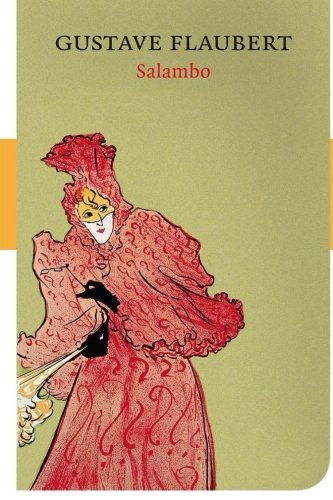
Salambo, by Gustave Flaubert

Free Ebook Salambo, by Gustave Flaubert
An historical novel that interweaves historical and fictional characters. The action takes place immediately before and during the Mercenary Revolt against Carthage in the third century BC. This book, which Flaubert researched painstakingly, is largely an exercise in sensuous and violent exoticism. The Carthaginian costumes described therein even left traces on the fashions of the time. Nevertheless, in spite of its classic status in France, it is practically unknown today among English-speakers.
Salambo, by Gustave Flaubert- Amazon Sales Rank: #1507281 in Books
- Published on: 2015-06-16
- Original language: English
- Number of items: 1
- Dimensions: 9.00" h x .31" w x 6.00" l, .40 pounds
- Binding: Paperback
- 122 pages
Language Notes Text: English, French (translation)
About the Author Known for his scrupulous devotion to his art and perfectionist style, French writer Gustave Flaubert is counted among the greatest Western novelists, and influenced such writers as Franz Kafka and J. M. Coetzee. Flaubert is best known for Madame Bovary, for which he was prosecuted (and acquitted) for offending public morals. His other works of note include Memoirs of a Madman, November, Salammb?, Sentimental Education, and The Temptation of Saint Anthony. His work has been widely adapted for the stage and screen. Flaubert died in 1880.

Where to Download Salambo, by Gustave Flaubert
Most helpful customer reviews
17 of 17 people found the following review helpful. The search for the forgotten realm. By ivan fernandez cabrera It seems at least surprising why Flaubert, a master of Realism, spent several years writing this novel placed in Carthago. At his time it was a very controversial issue, even though celebrated by critics and public, because of its sensuality which was criticised by eminent archaeologists. Gustave Flabert had made a very careful research, including several travels to Tunisia to figure out the exact settings of his plot, and thus he defended his work firmly. In the end, years afer, many of his proposals turned out to be certain. He took up this exhausting job in order to fulfill his taste for the exotic and even the grotesque in life. The main theme of the novel is the revolt of the mercenaries engaged by Carthago througout the Punic Wars against Rome. This army was formed by a bizarre variety of men from all over the Mediterranian lands, and like every army, they were loved at war and feared at peace. The novel begins with a feast given to honour their many years of sacrifice and loyalty. But soon after they are put apart to an inner region, feared by the citizens of the capital city. It is also the story of Matho, a Libian soldier, and Salambo, the Princess from Carthago. But this is just the starting line for Flaubert's displaying of his careful seek for the right word, le mot juste, and his amazing talent for showing the inner motivations of his characters. Summing up, this is a wonderful historic novel which does not only stand on long forgotten facts but on the rich depth of his characters. That is what makes it contemporary and close.
15 of 15 people found the following review helpful. Carnage in Carthage By Edward Perhaps wearied by his years in the company of the pathetic bourgeoise Emma Bovary, Gustave Flaubert chose as his next creation what may be the most extravagantly exotic novel ever written, "Salammbô". The critic Charles Augustin Sainte-Beuve called it "this laboriously artistic work" and the book, published in 1863, does require a great deal of patience from its readers. To begin with, there is the esoteric vocabulary: a suffete is a judge with tyrannical power, a hierodule is a temple slave, and the all-important zaïmph is a holy veil, the theft of which causes many problems for the main characters. Most of these characters are historical, such as Matho, Spendius, Hanno and the great Hamilcar himself. Hannibal appears as a ten-year old boy, saved from ritual sacrifice to the ravenous god Moloch by the ruthless machinations of his father. Hamilcar simply has a slave boy substituted, despite the parents' grief-stricken protests. (The famous pledge scene at the altar between Hamilcar and Hannibal is not presented here.) As for Salammbô, did she really exist? Obviously, Hamilcar had a daughter (his successor Hasdrubal is listed as his son-in-law) but evidently Polybius nor any other historian ever names the girl. In Flaubert she's an extremely strange and sensual character; at one point she's intimate with a python. Mind-boggled, I had to stop in mid-description, go back and start reading the passage again, but there it is: "The serpent ... gluing its tail to the ground, rose perfectly erect ...resting the centre of its body upon the nape of her neck, allowed its head and tail to hang ... Salammbô rolled it around her sides, under her arms and between her knees; then ... brought the little triangular mouth to the edge of her teeth ... {she} panted beneath the excessive weight, her loins yielded ... and with the tip of its tail the serpent gently beat her thigh." If you're wondering how mid-Victorians dealt with this description, I understand "Salammbô" was not translated into English until 1956. And if reptilian sex isn't enough for you, there are descriptions of torture, mutilations, cannibilism and (as mentioned before) the sacrifice of children, their parents being encouraged to chant "Lord, eat!" during the ceremony. All these events are centered around Hamilcar's suppression of a revolt of mercenaries and the enemy's threat of siege on Carthage in the years prior to 238 BC. It's a little difficult to follow the expeditions of Matho et al because the plan of Carthage and the geography of the surrounding countryside are awfully vague. Sainte-Beuve suggested that illustrative maps would be useful, and perhaps some future edition will include them. But for the time being the narrative itself, "glutted with sensations and abominations", is enough to hold a reader's fascination till the last violent page.
15 of 15 people found the following review helpful. An epic and sensual tale By F.Bluedevil Evil triumphs over evilFlaubert spent several years researching this book about an army of mercenaries who revolt against ancient Carthage.The book is a combination of history and myth not unlike Homer's Iliad. Like the Iliad it is a larger than life epic tale, but this tale has neither poetry nor heroes.Carthage does not want to pay the mercenaries their due; the mercenaries seek to plunder Carthage in revenge. Both sides rely on deceit and treachery to advance their cause.In the background, the sensual and mysterious Salammbo, seeking her own objective, indifferently and unwittingly affects the outcome.The war becomes long and brutal as the balance shifts back and forth. The horror of war becomes increasingly indefensible as the author offers neither heroes nor justifications. Fed only by greed, pride and revenge, the war and the slaughter grind on endlessly.Some would criticize, "This is not Madame Bovary, and this is too much violence without a point." Others would say, "This is not Madame Bovary, but to criticize that it is too much violence without a point, is to miss the point."Flaubert, painting with exquisite detail and unapologetic language, tells an epic, exotic and sensual tale of failure.
See all 14 customer reviews... Salambo, by Gustave FlaubertSalambo, by Gustave Flaubert PDF
Salambo, by Gustave Flaubert iBooks
Salambo, by Gustave Flaubert ePub
Salambo, by Gustave Flaubert rtf
Salambo, by Gustave Flaubert AZW
Salambo, by Gustave Flaubert Kindle

Tidak ada komentar:
Posting Komentar