The Festival of Insignificance: A Novel, by Milan Kundera
There is without a doubt that publication The Festival Of Insignificance: A Novel, By Milan Kundera will certainly constantly provide you inspirations. Also this is merely a publication The Festival Of Insignificance: A Novel, By Milan Kundera; you can find numerous genres as well as sorts of publications. From captivating to adventure to politic, and sciences are all offered. As just what we mention, here our company offer those all, from well-known authors as well as publisher worldwide. This The Festival Of Insignificance: A Novel, By Milan Kundera is among the compilations. Are you interested? Take it now. How is the method? Read more this post!
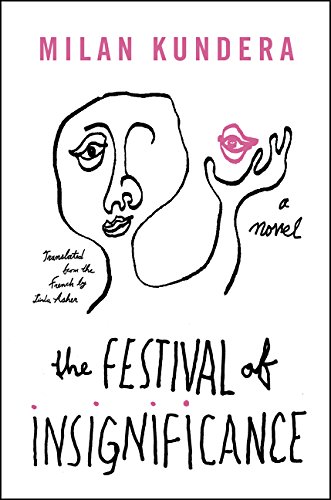
The Festival of Insignificance: A Novel, by Milan Kundera

Free Ebook PDF Online The Festival of Insignificance: A Novel, by Milan Kundera
From the internationally acclaimed, bestselling author of The Unbearable Lightness of Being, an unexpected and enchanting novel—the culmination of his life's work.
Casting light on the most serious of problems and at the same time saying not one serious sentence; being fascinated by the reality of the contemporary world and at the same time completely avoiding realism—that’s The Festival of Insignificance. Readers who know Milan Kundera’s earlier books know that the wish to incorporate an element of the “unserious” in a novel is not at all unexpected of him. In Immortality, Goethe and Hemingway stroll through several chapters together talking and laughing. And in Slowness, Vera, the author’s wife, says to her husband: “you’ve often told me you meant to write a book one day that would have not a single serious word in it…I warn you: watch out. Your enemies are lying in wait.”
Now, far from watching out, Kundera is finally and fully realizing his old aesthetic dream in this novel that we could easily view as a summation of his whole work. A strange sort of summation. Strange sort of epilogue. Strange sort of laughter, inspired by our time, which is comical because it has lost all sense of humor. What more can we say? Nothing. Just read.
The Festival of Insignificance: A Novel, by Milan Kundera- Amazon Sales Rank: #205501 in Books
- Brand: Harper
- Published on: 2015-06-23
- Released on: 2015-06-23
- Format: Deckle Edge
- Original language: English
- Number of items: 1
- Dimensions: 8.25" h x .57" w x 5.50" l, .0 pounds
- Binding: Hardcover
- 128 pages
Review “There is a timeless quality to his philosophy about the importance of laughter…Kundera is still the powerful and incisive writer he always was.” (New York Times Book Review)“Compelling…That Kundera has his tongue half in his cheek is part of the charm… offers both a continuation of Kundera’s signature investigations and a reaction to the toxicity of the present day.” (Los Angeles Times)“Kundera doesn’t present himself as a priest of the novel who, having been inducted into its higher mysteries, now deigns to share his brilliance with mere mortals. He is simply one character among others in the novel, curious, perplexed, and amused by the spectacle of human nature.” (New Republic)“Kundera is a master at uniting disparate characters by tracing their intersecting journeys, and by allowing resonant words inside the head of one character to sing inside the thoughts of another.” (The Atlantic)“An entertaining divertissement, a lightly comic fiction blending Gallic theorizing and Russian-style absurdity…This is, in short, just the book for an idle afternoon spent sipping espresso and watching the passing show on the Boulevard Saint-Michel or Connecticut Avenue.” (Michael Dirda, Washington Post)“Stunningly profound…a late-career confection which, in its compact slimness, re-proves Kundera’s chops when it comes to overlapping narratives and beautifully expressing the junk and clutter of the modern world.” (NPR Books)“Slender but weighty, thoroughly cerebral…It comes as a welcome corrective to so much American-style realist fiction, which in heavy doses can blur into a kind of sameness…what is moving about this novel is its embrace of what has always driven Kundera, the delicate state of living between being and nothingness. Far from rehashing this theme, it presses it into new form: shorter, tighter, fired by aging rather than by coming of age. It would be a poor fit for Hollywood, but it’s a perfect one for Kundera, and for anyone who has looked at life in hindsight.” (Boston Globe)“This slight but wonderful novel offers its own distinct brand of pleasure… a fitting capstone on an extraordinary career.” (Benjamin Herman, Slate)“[Kundera] stands in the West as the representative Eastern European author of the second half of the 20th century-and the most celebrated Czech writer since Kafka… a wily, playful, feather-light novella…It seems fitting that he should end his career not with a bang but a giggle.” (Wall Street Journal)“This novel is a fitting bookend to Kundera’s long career intersecting the absurd and the moral.” (Publishers Weekly)“Forgotten tyrants and blatant belly buttons have equally playful roles in this deceptively slight, whimsically thoughtful tale of a few men in Paris…This strangely amusing novella has the power to inspire serious efforts to find significance in the very book in which it is so perversely denied.” (Kirkus Reviews (starred review))“Stylistically and thematically, it’s classic Kundera: polyphonic, digressive, intellectual yet anti-philosophical, deliberately strange, and aggressively light. And his descriptions are as beautiful as ever.” (Booklist)“His first novel in almost 15 years, Kundera takes us on a journey where the only thing that really matters to his four characters is the word ‘friendship’. Another beautiful work from Kundera, he casts light on serious issues while not saying anything serious at all.” (The Reading Room)“Its lightness is heavy with the weight of previous Kundera books, so a Stalin reference blooms with additional meaning -- because it’s been set so strikingly against previous portrayals of communism.” (Huffington Post)“Poignant, surreal, and funny…” (The Millions)“Enjoyable…readers will be very pleased with this latest release from Kundera, which has all the wit and humour of his earlier Immortality, but adds to this a unique and careful attention to unknown characters’ lives.” (Publish ArtsHub)
From the Back Cover
Casting light on the most serious of problems and at the same time saying not one serious sentence; being fascinated by the reality of the contemporary world and at the same time completely avoiding realism—that's The Festival of Insignificance. Readers who know Kundera's earlier books know that the wish to incorporate an element of the "unserious" in a novel is not at all unexpected of him. In Immortality, Goethe and Hemingway stroll through several chapters together, talking and laughing. And in Slowness, Vera, the author's wife, says to her husband, "You've often told me you meant to write a book one day that would have not a single serious word in it . . . I warn you: watch out. Your enemies are lying in wait."
Now, far from watching out, Kundera is finally and fully realizing his old aesthetic dream in this novel, which we may easily view as a summation of his whole work. A strange sort of summation. Strange sort of epilogue. Strange sort of laughter, inspired by our time, which is comical because it has lost all sense of humor. What more can we say? Nothing. Just read.
The Franco-Czech novelist Milan Kundera was born in Brno and has lived in France, his second homeland, since 1975. He is the author of the novels The Joke, Life Is Elsewhere, Farewell Waltz, The Book of Laughter and Forgetting, The Unbearable Lightness of Being, and Immortality, and the short story collection Laughable Loves—all originally in Czech. His more recent novels, Slowness, Identity, and Ignorance, as well as his nonfiction works, The Art of the Novel, Testaments Betrayed, The Curtain, and Encounter, were originally written in French.
About the Author
Milan Kundera is the author of the novels The Joke, Farewell Waltz, Life Is Elsewhere, The Book of Laughter and Forgetting, The Unbearable Lightness of Being, and Immortality, and the short-story collection Laughable Loves—all originally written in Czech. His most recent novels Slowness, Identity, and Ignorance, as well as his nonfiction works The Art of the Novel, Testaments Betrayed, The Curtain, and Encounter, were originally written in French.

Where to Download The Festival of Insignificance: A Novel, by Milan Kundera
Most helpful customer reviews
39 of 42 people found the following review helpful. Kundera's conversion to French intellectual is complete By R L B Kundera's conversion to French intellectual is complete.When we first encountered Kundera a few decades ago, his books had purpose, real characters and a sense of political engagement along with a roguish earthiness. His voice was distinct, as was the Czech accent it conveyed.Now, after living for many years in France, the aptly named "Festival of Insignificance" marks Kundera's complete conversion to French intellectual. The book is short, has no real story, no real characters, and much discussion of well-worn philosophy. There are references to Schopenhauer, Kant and Hegel, and a nice story about Stalin on which too much weight is placed. The book starts quite literally with navel-gazing and we return to an examination of the navel in its closing pages. As an exercise in navel-gazing and intellectual noodling - "nombrilistique", as the French would say - this is a perfect example of the contemporary French novel, and should win the Prix Goncourt."The Festival of Insignificance" is not without entertainment value. It will happily occupy two hours on a quiet afternoon. It is good that it is not longer, because if it was only 20 or 30 pages longer I am sure it would cross the border into tedium. However, I cannot recommend this book except to those who, probably like me, will pick up any new book with Kundera's name on it as soon as it appears in the bookstore. It is too slight, too empty and too much of a departure from the original Kundera.
10 of 11 people found the following review helpful. Dark and dry humor I enjoyed immensely. The title sums it up. By Amazon Customer **I received a copy of The Festival of Insignificance through a Goodreads giveaway I won. This review is comprised of my own candid opinions.**The Festival of Insignificance is a brief and concise story filled with many musings that I quickly realized were just as the title suggests. Actually, rather than call it a story at all, I'd say it's an internal rambling done so on purpose. We have several French characters who for their own reasons are either bored with life or seeking more from it. In turn, each of these characters seems to be unaware or unable to enjoy their simple reality without resorting to grandiose analysis or action.I mean, we have a character, D'Ardelo, faking cancer so he can see how much value his friends put on his life when he could be busy celebrating his newfound health. Another character, Alain, cannot seem to move on from the mother who abandoned him when he was small, and so he obsesses with mental visuals of what must have caused her to do so even though she has no bearing on the present. Caliban, who amuses himself with pretending not to speak the language of the rich people he caters for, comes across a beautiful girl trying to communicate with him. Alas, despite their instant mutual attraction, he can't backtrack from his ridiculous lie and just ask her out.Coupling these different scenarios to the flashbacks of Stalin, and how Stalin entertained himself by making his own men suffer through long-winded stories, I found it all comical. It is comical, nonsensical, and none of the strings to this plot continue a thread of importance by the end.This is my first time reading one of Kundera's works. I am surprised to see many longtime Kundera fans did not enjoy this as much as I did. This book delivers wholeheartedly on what the title promises. I don't know what the author intended me to take from it specifically, but through all of the dark and dry humor, this is what I was left to think.Whether you're a miserable world leader who plays practical jokes on his men, the poor man who pisses himself while Stalin plays the joke on you, or the modern day Parisian characters who are restless with their own existence, each and every one matters little with time. One day we're all bound to be forgotten in some regard or reinvented by someone who will never know the real microscopic details of our lives.Kundera references insignificance in our surroundings as true enjoyment, things such as children's laughter and scenic beauty (and yes, those darn curious navels). I guess I enjoy the idea that maybe in all of our efforts to be singly important or philosophical over existence, we might be missing out on all of the tiny insignificant things that make being alive enjoyable in the first place.If that wasn't the point, then I don't know what is. Maybe the point this legendary author is making is there is no grand point to make about this crazy, strange thing called life. I feel that quite possibly this was an epilogue of levity after a career of deep philosophical thought. I can at least gather that Milan Kundera was amusing himself with many thoughts that may or may not matter at all.
9 of 10 people found the following review helpful. THE ULTIMATE DANCE of BEING and NONBEING -- "LEELA" By C J Singh The Festival of InsignificanceBy Milan Kundera.Reviewed by C J Singh (Berkeley, California).The ULTIMATE DANCE of BEING and NONBEING -- "LEELA"Milan Kundera, a French novelist of Czech origin, is widely regarded as one of the leading contemporary European writers, a top contender for the Nobel. Known for writing novels of ideas, his international best-selling novel, “The Unbearable Lightness of Being,” cited Nietzsche. It was filmed to great acclaim by French screenwriter Jean-Claude Carriere (of “Mahabharata” fame) and American director Philip Kaufman.THE FESTIVAL OF INSIGNIFICANCE cites the philosopher Schopenhauer. Kundera masterfully introduces the setting and all of principal characters in the opening 12-page chapter, with glimpses into their backstories and characterizing details. Alain, sauntering on Paris streets, has lately been observing “the young girls, who--every one of them –-showed her naked navel between trousers belted vey low and a T-shirt cut very short,” visualizing the exposed navel as the new seductive zone. “At about the same time,” Ramon strolling in the Luxembourg Gardens comes across D’Ardelo who is returning from his medical exam. The doctor, gripping D’Ardelo’s hand “in a brotherly fashion,” had informed him that his suspected symptoms of cancer had disappeared completely. However, D’Ardelo looking into the aging face of Ramon, a former colleague, just a year older than him and recently retired, chooses to tell him the lie that he has cancer. Why? This is skillfully presented as a mystery via psychologically linked associations. D’Ardelo says, “ ‘Listen, my friend—do you know La Franck, the great Madame Franck? Two days ago her partner died.’ He paused, and in Ramon’s mind there appeared the face of a famous beauty he knew only from photographs.” Throughout the novel, Kundera effectively uses shifting close third-person points of view of nearly all of his characters. “ ‘But imagine—the very evening of the morning she’d held his dying body in her arms, she had dinner with a few friends and myself, and you wouldn’t believe it—she was almost merry! I was so impressed. What strength! What love of life! Her eyes were still red from tears, and here she was laughing! And yet we all knew how much she’d loved him! How she must have suffered! The power in the woman!’” Is his linkage weak so far? “As he spoke of Madame Franck’s spirit, he was thinking of himself. Hadn’t he also lived for a whole month in the presence of death? Hadn’t his own character been put through a harsh ideal as well? Even now that it was only a memory, the cancer stayed with him like the glow of a small bulb, that, mysteriously amazed him.” Kundera, as narrator, writes: “But I cannot help wondering: Why did D’Ardelo lie? D’Ardelo asked himself that question immediately afterward, and he did not know the answer either.” Here, Kundera exemplifies postmodernist authorial intrusion, an intrusion that deepens his narrative.Before parting from Ramon, D’Ardelo asks him to help arrange his upcoming birthday party. Ramon knowsCharles, a professional cocktail party arranger, and his assistant, Caliban, a jobless theatrical actor. Ramon hastens to Charles’s apartment to give him the good news of the job offer. “Bravo! We’ll need it this year,” said Charles … and later asked, “Who is this D’Ardelo? A jackass like all my clients?” “Of course.” “And what’s his brand of stupidity?” “You know my friend Quaquelique?... one of the greatest womanizers I have ever known. Once I went to a reception where both of them were present, d’Ardelo and he. They didn’t know each other. … There were some fine-looking women there, and d’Ardelo is crazy for them.” Ramon goes on to show how the narcisstic D’Ardelo often loses out with his “witty talk shot from his mouth like fire-works, so difficult to understand.” He waits for three or four seconds and then “breaks into laughter himself, and a few seconds go by before his listeners understand and politely join in. Qualquelique’s way is the opposite.” Ramon explains Qualquelique’s winning technique is to murmur sotto voce, not silence because that invites suspicion, just murmuring. D’Ardelo technique arouses defensive response in women, “whereas insignificance sets her free … more accessible.” D’Ardelo has not understood “the value of insignificance.”In Charles’s apartment, Ramon sees a thick book on the table “The memoirs of Nikita Khrushchev.” This skillfully introduces Stalin’s “story of the twenty-four partridges,” which will later serve Kundera in taking off into the realm of his forte, posing philosophical issues in his novels. Here, Kundera questions Kant’s concept of “das Ding an sich” as argued by Shopenhauer (pp. 89-90.). D’Ardelo’s party will be the insignificant festival of insignificance that ends this short novel significantly. Significantly, because the novel evokes existential questions in the direct context of Western civilization and the indirect context of Eastern civilization via Schopenhauer’s acknowledged influence of Hindu philosophy on his opus, “The World as Will and Representation.”Arthur Schopenhauer regarded his reading of the "Upanishads" – Chandogya Upanishad, in particular -- as the major inspiration of his philosophy of “The World as Will and Representation,” published in 1818. Schopenhauer wrote: “The Upanishads are the production of the highest human wisdom … the native pantheism of India, which is destined sooner or later to become the faith of the people. Ex oriente lux .” Schopenhauer’s work influenced Tolstoy, Freud, Jung, Rilke, among numerous other European and American intellectuals like Emerson, Walt Whitman, Thoreau.On page 90, Kundera has the historical Stalin say, “Schopenhauer came closer to the truth. And what my friends, was Schopenhauer’s great idea? …. Schopenhauer’s great idea, my friends, was that the world is only will.” Stalin’s malefic “will” characterizes Stalin accurately. Kundera makes his character Caliban pretend to speak only "Pakistani." Had he made Caliban speak Sanskrit, the novel would have come closer to the festival of insignificance or “LEELA,” the ultimate Cosmic Game of Being and Nonbeing. Advaita (Sanskrit for non-dualism) presents reality as maya (illusion).The name "Caliban" in the Indo-European language, Romani, suggests black dweller of the forest. Historically, the Romani (Gypsy) people were in England many decades before Shakespeare's time—journeying from India to Iran, Armenia, Greece, Bulgaria, and further west in Europe. The Romani people remain to this day the most discriminated ethnic minority in Europe surviving there at the very margins for seven centuries. In recent years, according to the European Union’s commissions on human rights for the Romani people, both the Czech Republic, Kundera’s country of origin, and France, his adopted country, have been two of the worst offenders in their treatment of the Romani people.Because of their colonial haughtiness, the English and French have stubbornly ridiculed the contributions of India to European philosophy and science for a long time. Not all, of course. Voltaire, for example, read the Latin translation of the Sanskrit classic work of Indian philosophy, the “Upanishads," and wrote glowingly about it. "We have shown how much we surpass the Indians in courage and wickedness, and how inferior to them we are in wisdom. Our European nations have mutually destroyed themselves in this land where we only go in search of money, while the first Greeks travelled to the same land only to instruct themselves." -- Voltaire, Fragments historiques sur l'Inde (first published Geneva, 1773), Oeuvres Completes (Paris : Hachette, 1893), Vol.29, p.386. "I am convinced that everything has come down to us from the banks of the Ganges, astronomy, astrology, metampsychosis, etc." -- Voltaire, Lettres sur l'origine des sciences et sur celle des peuples de l'Asie (first published Paris, 1777), letter of 15 December 1775. "No sooner than India began to be known to the Occident's barbarians than she was the object of their greed, and even more so when these barbarians became civilised and industrious, and created new needs for themselves.... The Albuquerques and their successors succeeded in supplying Europe with pepper and paintings only through carnage." -- Voltaire, Fragments historiques sur l'Inde, op.cit., p.383)In recent decades, European prejudice has lessened a little. For example, the installation of the tall statue of Shiva as Nataraja at the Center for European Research in Particle Physics (CERN) in Geneva. The Shiva statue in the dancing pose of the Cosmic Dance of Being and Nonbeing, holding the flame in one of his hands. Another example is the systematic documentation of India's 4500 years of contributions to Mathematics by Professor Ian Pearce of St. Andrews University: http://www-history.mcs.st-andrews.ac.uk/history/Projects/Pearce/index.htmlKundera succeeds in writing an engaging novel about ultimate insignificance. He deserves to win the Nobel for his impressive body of literary contributions.-- c j singh
See all 41 customer reviews... The Festival of Insignificance: A Novel, by Milan KunderaThe Festival of Insignificance: A Novel, by Milan Kundera PDF
The Festival of Insignificance: A Novel, by Milan Kundera iBooks
The Festival of Insignificance: A Novel, by Milan Kundera ePub
The Festival of Insignificance: A Novel, by Milan Kundera rtf
The Festival of Insignificance: A Novel, by Milan Kundera AZW
The Festival of Insignificance: A Novel, by Milan Kundera Kindle

Tidak ada komentar:
Posting Komentar