Lisette's List: A Novel, by Susan Vreeland
After downloading and install the soft file of this Lisette's List: A Novel, By Susan Vreeland, you can begin to read it. Yeah, this is so delightful while somebody should check out by taking their big publications; you remain in your new way by only handle your device. Or even you are operating in the office; you can still make use of the computer system to check out Lisette's List: A Novel, By Susan Vreeland totally. Of course, it will certainly not obligate you to take numerous web pages. Just web page by page depending upon the moment that you have to read Lisette's List: A Novel, By Susan Vreeland
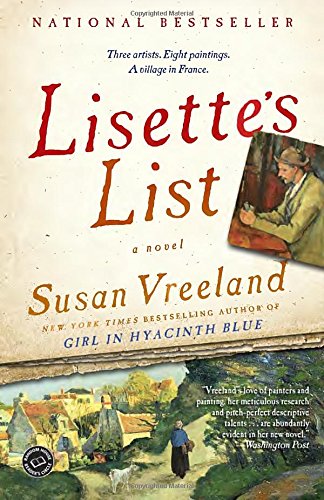
Lisette's List: A Novel, by Susan Vreeland

PDF Ebook Download : Lisette's List: A Novel, by Susan Vreeland
From Susan Vreeland, bestselling author of such acclaimed novels as Girl in Hyacinth Blue, Luncheon of the Boating Party, and Clara and Mr. Tiffany, comes a richly imagined story of a woman’s awakening in the south of Vichy France—to the power of art, to the beauty of provincial life, and to love in the midst of war. In 1937, young Lisette Roux and her husband, André, move from Paris to a village in Provence to care for André’s grandfather Pascal. Lisette regrets having to give up her dream of becoming a gallery apprentice and longs for the comforts and sophistication of Paris. But as she soon discovers, the hilltop town is rich with unexpected pleasures. Pascal once worked in the nearby ochre mines and later became a pigment salesman and frame maker; while selling his pigments in Paris, he befriended Pissarro and Cézanne, some of whose paintings he received in trade for his frames. Pascal begins to tutor Lisette in both art and life, allowing her to see his small collection of paintings and the Provençal landscape itself in a new light. Inspired by Pascal’s advice to “Do the important things first,” Lisette begins a list of vows to herself (#4. Learn what makes a painting great). When war breaks out, André goes off to the front, but not before hiding Pascal’s paintings to keep them from the Nazis’ reach. With German forces spreading across Europe, the sudden fall of Paris, and the rise of Vichy France, Lisette sets out to locate the paintings (#11. Find the paintings in my lifetime). Her search takes her through the stunning French countryside, where she befriends Marc and Bella Chagall, who are in hiding before their flight to America, and acquaints her with the land, her neighbors, and even herself in ways she never dreamed possible. Through joy and tragedy, occupation and liberation, small acts of kindness and great acts of courage, Lisette learns to forgive the past, to live robustly, and to love again.Look for special features inside. Join the Random House Reader’s Circle for author chats and more. “Vreeland’s love of painters and painting, her meticulous research and pitch-perfect descriptive talents . . . are abundantly evident in her new novel.”—The Washington Post “This historical novel’s . . . great strength is its lovingly detailed setting. . . . Readers will enjoy lingering in the sun-dappled, fruit-scented Provençal landscape that Vreeland brings to life.”—The Boston Globe “A pleasurable opportunity to learn something about art, history . . . and to enjoy a plucky heroine who grows in ways she never thought possible.”—St. Louis Post-Dispatch “Mesmerizing . . . Vreeland’s passionate writing is as good as a private showing at the Louvre.”—Kirkus Reviews (starred review) “An entrancing novel of joy and heartache . . . Vreeland provides the reader with a broad spectrum of emotions.”—The Free Lance-Star
Lisette's List: A Novel, by Susan Vreeland- Amazon Sales Rank: #29731 in Books
- Brand: Vreeland, Susan
- Published on: 2015-06-23
- Released on: 2015-06-23
- Original language: English
- Number of items: 1
- Dimensions: 7.99" h x .94" w x 5.21" l, .0 pounds
- Binding: Paperback
- 448 pages
Review “[Susan] Vreeland’s love of painters and painting, her meticulous research and the pitch-perfect descriptive talents that distinguished such books as Girl in Hyacinth Blue and Luncheon of the Boating Party are abundantly evident in her new novel.”—The Washington Post “[Lisette’s List] great strength is its lovingly detailed setting, a mountaintop village—‘like some fantasy kingdom from a child’s folk legend, altogether dazzling’—whose charm gradually enwraps the reader just as it does the initially resistant Lisette. . . . Readers will enjoy lingering in the sun-dappled, fruit-scented Provençal landscape that Vreeland brings to life.”—The Boston Globe “Part romance, part historical fiction, part travelogue, part art history text . . . Vreeland knows her art, she knows Provence, and she’s done her historical homework. . . . Lisette’s List offers its readers a pleasurable opportunity to learn something about art, history and ocher, and to enjoy a plucky heroine who grows in ways she never thought possible.”—St. Louis Post-Dispatch “Mesmerizing . . . Vreeland’s passionate writing is as good as a private showing at the Louvre.”—Kirkus Reviews (starred review) “An entrancing novel of joy and heartache . . . Vreeland provides the reader with a broad spectrum of emotions.”—The Free Lance-Star“The novel’s heart is its patient interweaving of sensuous, meticulously observed details with themes of forgiveness, female strength, and survival.”—Publishers Weekly “Lisette’s List is heartfelt, loving and lovely, and asks difficult questions beautifully.”—Shelf AwarenessFrom the Hardcover edition.
About the Author
Susan Vreeland is the New York Times bestselling author of eight books, including Clara and Mr. Tiffany and Girl in Hyacinth Blue. She lives in San Diego.
Excerpt. © Reprinted by permission. All rights reserved. Chapter OneRoad to Roussillon1937Amid the crowd of travelers darting in front of the Avignon train station, the delivery boys on ancient bicycles swerving between children and horse carts, and the automobile drivers honking their horns, André stood relaxed, eating an apple from a fruit stand. Meanwhile, I paced in a tight circle around our carpetbags, our valises, and our crates filled with everything we could take with us from our apartment in Paris, plus the tools from his workshop, plus the dream of my life sacrificed.“Are you sure we’re in the right place?” I asked.“Yes, Lisette.” André plucked a broad leaf off a nearby plane tree and laid it on a cobblestone. He touched my nose with his index finger and then pointed to the leaf. “He’ll park right there. On that cobblestone. Just watch.” He squeezed my hand. “In the south of France, things happen as they should.”But apparently in the south of France, buses didn’t operate on schedule, as they did in Paris. Nor did the light have the same effect as it did there. Here, the light singed the eye, wrapped itself around edges, intensified colors, ignited the spine. If it were otherwise, I would not have recognized the loveliness in a bare square that was not Paris, but there it was—a shimmering watercolor of fathers and grandfathers sitting under the plane tree, their white shirts blued by the cornflower sky, which found openings in the foliage, the men eating almonds from a paper bag, passing it from one end of the bench to the other and back again, perhaps talking of better days. They looked content, sitting there, while I withdrew my hand from André’s and made another senseless circuit around the modest pile of our belongings, feeling his gaze following me.“Look at them,” André said in a low voice. “All members of the Honorary Order of Beret Wearers.” He chuckled at his own invention.Eventually a boxy little bus, a faded relic once painted orange beneath its rust, sputtered to a stop, the right front wheel crushing the leaf on the cobblestone. André tipped his head and gave me an excusably smug but tender smile.The stocky driver bounded down the steps, nimble-footed, pointing his toes outward as weighty people do to keep their balance. He hailed André by name, reached his thick arm up to slap him on the back, and said he was glad to see him.“How’s Pascal doing?” André asked.“He gets around all right most days. Louise takes him his meals or he eats with us.”The driver bowed to me with exaggerated courtliness.“Adieu, madame. I am Maurice, un chevalier de Provence. A knight of the roads. Not, however, Maurice Chevalier, who is a knight of the stage.” He sent André a wink. “Your wife, she is more beautiful than Eleanor of Aquitaine.”Foolishness. I would not fall for it.Had he said Adieu? “Bonjour, monsieur,” I responded properly.I was amused by his attire—a red cravat above his undershirt, the only shirt he wore, which dipped in front to show his woolly chest; a red sash tied as a belt; his round head topped by a black beret. Black hair curled out from his armpits, a detail I could have done without noticing, but I am, thanks to Sister Marie Pierre, the noticing type.He placed a hand over his fleshy bosom. “I deliver ladies in distress. Enchanté, madame.”I gave André a doleful look. I was in distress that very moment, already missing the life we had left behind.“Vite! Vite! Vite!” The driver circled his arm around our bags in three quick movements, urging us to move quickly, quickly, quickly. “We leave in two minutes.” Then he was gone.“One vite was enough, don’t you think?”With a wry twist of his mouth, André said, “People in Provence speak robustly. They live robustly too. Especially Maurice.” André began loading our bags and crates. “He’s a good friend. I’ve known him ever since I was a boy, when Pascal used to take me to visit Roussillon.”“What’s the red sash for?”“It’s a taillole. It signifies that he’s a native son, a patriot of Provence.”We waited ten minutes. Two men took seats in the back of the bus. Soon I heard robust snoring.Our self-proclaimed chevalier finally scurried back. “Sorry, sorry. I saw a friend,” he said, working every feature of his round face, even his wide nostrils, into a smile of innocence, as though having seen a friend naturally justified the delay. He pumped up the tires with a hand pump—robustly, I observed—and started the engine, which choked in resistance, then lurched us ahead under the stone arch spanning the ramparts and out into the countryside to the east.The road to Roussillon between two mountain ranges, the Monts de Vaucluse to the north and the Luberons to the south, kept me glued to the window. I had never been to the south of France.“Stop here!” André ordered. The bus came to a shuddering stop and André hopped out, plucked a fistful of lavender growing wild along the roadside, climbed back in, and presented it to me. “To welcome you to Provence. I’m sorry it’s not in its full purple bloom yet. In July you’ll be astonished.”A sweet gesture, sweet as the fragrance itself.“How far is it to this Roussillon place?” I asked the driver as we started down the road again.“Forty-five beautiful kilometers, madame.”“Look. I think those are strawberry fields,” André said. “You love strawberries.”“And melons,” Maurice added with a nasal twang. “The best melons in France are grown right here in the valleys of the Vaucluse. And asparagus, lettuce, carrots, cabbages, celery, artichokes—”“Yes, yes,” I said. “I get the idea.”He would not be yes-yessed. “Spinach, peas, beets. On higher ground, our famous fruit trees, vineyards, and olive groves.”He pronounced every syllable, even the normally mute e at the ends of some words, which made the language into something energetic, decorated, and bouncy instead of smoothly gliding, as it is in Paris.“Apricots. You love them too,” André said. “You are entering the Garden of Eden.”“I see one snake and I’m taking the next train back to Paris.”I had to admit that the fruit trees, laden with spring blossoms, exuded a heavenly fragrance. The grapevines were sprouting small chartreuse leaves, wild red poppies decorated the roadside, and the sun promised warmth, so welcome after a frigid winter in Paris.But to live here for God knows how long—I had more than misgivings. For me to surrender the possibility of becoming an apprentice in the Galerie Laforgue, the chance of a lifetime for a woman of twenty with no formal education, had already caused resentment to surface in me. When André had made what seemed an impulsive decision to leave Paris and live in a remote village just because his grandfather had appealed to him to keep him company in his failing health, I’d been shocked. That he would so easily abandon his position as an officer of the Guild of Encadreurs, the association of picture-frame craftsmen, a prestigious position for a man of twenty-three, was inconceivable to me.I had gone crying to Sister Marie Pierre at the Daughters of Saint-Vincent-de-Paul, the orphanage where I had been raised, complaining that he was shortsighted and selfish, but she had given me little sympathy. “Judge not, Lisette. See him in the best light, not the worst,” she’d said. And so here I was, bumping along in clouds of dust, despairing that I wasn’t in Paris, city of my birth, my happiness, my soul.Following Sister Marie Pierre’s advice to try to see the situation in the best light, I ventured a possibility. “Tell me, monsieur. Does this town of yours have an art gallery?”“A what?” he screeched.“A place where original paintings are sold?”He howled a laugh from his belly. “Non, madame. It is a village.”His laughter cut deeply. My yearning for art was nothing casual or recent. Even when I was a little girl, this longing had been a palpable force every time I stole into the chapel of the Daughters of Saint-Vincent-de-Paul to look at the painting of the Madonna and Child. How a human being, not a god, could re-create reality so accurately, how the deep blue of her cloak and the rich red of her dress could put me, a young orphan without a sou to my name, in touch with all that was fine and noble, how such beauty could stir something in me so deep that it must have been what Sister Marie Pierre called soul—such things drenched me with wonder.André jiggled my arm and pointed out a cluster of red geraniums spilling over the window box of a stone farmhouse. “Don’t worry. You’re going to like it here, ma petite.”Because of geraniums?“Certainement, she will,” Maurice chimed in from behind the wheel. “Once she becomes accustomed to les quatre vérités.”Four truths? “And what might they be, monsieur?”“You see three of them right here.” He took his arm off the steering wheel to wave vaguely at the countryside, apparently able to drive and listen and talk and gesture all at once. Presumably that was a skill of living robustly. “The mountains, the water, the sun.”True enough. The sunlight made the snow on the peak of a mountain to the north blindingly white. It shone on a river to the south in dancing specks of brilliance and turned the canals into iridescent silver-green ribbons.“And what’s the fourth, monsieur?”“It can’t be seen, and yet its mark is everywhere.”“A riddle. You’re telling me a riddle.”“No, madame. I’m telling you a truth. André, he knows.”I turned to André, who tipped his head toward the window and said, “Think and look. Look and think.”I studied the landscape for some mark.“Does it have to do with those stone walls?” They were actually only remnants of walls, piles of flat stones forming barriers nearly a meter thick, some with wayside niches for figures of saints, I presumed, although I hadn’t seen any.“No, madame. Those were built in the Middle Ages to keep out the plague.”“Not a comforting thought, monsieur. Neither is that scraping noise. Is there something wrong with your brakes?”“No, madame. You are hearing the sound of cigales. Insects that make their mating calls when the temperature gets warm.”Definitely something I would have to get used to. Thickly planted cypress trees lined the north sides of the vegetable fields. Their pointed shadows stretched toward us like witches’ gray fingers.Looking from side to side, I noticed another peculiarity. “Why don’t the houses on the right side have windows facing the road, while the ones on the left side do?”“Now you’re thinking. Look. They all have windows on three sides, but not on the north.”But why? Did the sun glare through north windows too strongly? No. It would shine from the south, giving light to only half of the house. The other half would be dark and gloomy.When I asked André for a hint, he told me to look at the roofs. They were terra-cotta tiles, long, tubular, and overlapping. Flat stones had been placed at their northern edges.From the Hardcover edition.

Where to Download Lisette's List: A Novel, by Susan Vreeland
Most helpful customer reviews
39 of 41 people found the following review helpful. Art and Love in WWII Provence By Nancy Famolari Just before the start of WWII, Andre moves with his bride Lisette from Paris to Roussillon in the south of France. Andre's grandfather, Pascal, is ill, possibly dying, and Andre wants to care for him. Lisette understands, and she loves Andre, but she fears that her dream of working in a Paris art gallery is gone forever.In Roussillon, Lisette gets a surprise. Pascal has collected impressionist paintings from Pissaro and Cezanne. He tells her the history of the pictures and stories of the artists. After Pascal dies, France is drawn into WWII. Paintings, particularly those of the impressionists, are being destroyed so Andre hides the paintings before enlisting and going to the front.This book is both a love story and a look at art history before and during WWII. The stories about the painters are fascinating as is the historical background on how artists were treated. Marc Chagal and his wife Bella are characters in the story and present a picture of the plight of Jewish artists.I found the book fascinating. The art history and the background of WWII makes the story of another time come alive. However, the novel moves slowly.Lisette, the main character, grows through her determination to survive the war. In the opening scenes, she comes across as spoiled and resentful. Getting to know Pascal and hearing the history of his pictures changes her outlook, but real growth comes when she is left alone in Roussillion. She realizes how much she loves Andre and determines to survive the war and recover the paintings. Her list enumerates the things she must do to survive the war and cope with the problems of Nazi occupied France. While her struggle is interesting, the pace is very leisurely.I recommend the book if you enjoy the combination of art, history, and romance, but be prepared for a long read.
19 of 20 people found the following review helpful. A MASTERPIECE! Love, art, history, war, loss, courage........Profoundly great read. By kindred spirit What a rich well written story. I will admit at points slow and I had a hard time right at first getting interested but about page 50 I couldn't put it down. There is romance, history, suspence, intrigue, mystery so full and interesting.Coming from an artistic family it was especially fun for me to learn more about the great bravery of those who hid the precious art from the Nazi's who stole and destroyed whatever they pleaded.Lisette and Andre are young and just married living in Paris when his grandpa Pascal writes he is sick and needs them. They pack up and move to a town one and a half days travel from their beloved Paris. Lisette has a hard time adjusting especially when they find Pascal not that sick at all. No bathroom in the house, I cannot imagine running down to the town outhouse. What her artist husband does about this is precious. I will not spoil those details.As Pascal does decline in health war has broken out and Hitler is heading toward France. Andre feels the need to fight for his country leaving Lisette behind. During this time she starts her List. LISETTE'S LIST OF HUNGARS AND VOWS. She begins ti decide what is most important. She come incontact with the resistance, hidden Jews, hidden art and she has hidden art given to her by Pascal on his death bed. Thus begins excitment and great danger and risk taking. Don't worry I have left out huge things don't want to spoil it for you. If you like history of WWII art and romance this is for you. There are so many things that are just profound I want to share all my highlights but also want you to come upon them yourself. I leave you with one such statement. "When a man finds a place he loves, he can endure the unspeakable."Don't let a slow start stop you from reading a fantastic book.UPDATE: I just had to come back and say more. The mark of a great book is days after you read it you cannot stop thinking about the people, almost wondering how they are doing. I'm still going back and reading things I underlined. Just have to share more...not a spoiler. "Self sufficiently doesn't only have to do with living alone and providing for oneself. It's finding in oneself the qualities that make a person unique, and being content with them." Love this wisdom shared in this book. Another..."The thing to do is to stay close to the light. That is where love is."This is a must read, then a reread!
31 of 36 people found the following review helpful. ART HISTORY IN DISGUISE By Red Rock Bookworm Sue Vreeland's LISETTE'S LIST is essentially written on two levels and while it does an admirable job in recounting certain aspects of WWII as well as presenting an art history lesson focusing on the fate of paintings by Pissarro, Cezanne, Picasso and Chagall during the German occupation of France it is not as effective in fulfilling expectations in the areas of plot intensity nor in character motivation and development.Lisette, the title character, is a Parisian girl raised in a Catholic orphanage where she experiences the beginnings of her appreciation of art. After her marriage to Andre she reluctantly relocates to his home town in Provence in 1937 in order to provide care for his elderly grandfather Pascal, a man who has accumulated several works by the aforementioned masters. Pascal's reminiscence concerning his acquisition of the various works becomes part and parcel of the story.With the outbreak of WWII and the Nazi occupation of France, Andre enlists in the military, but not before hiding his grandfather's precious paintings and Lisette is left to try to assimilate into a town where some view her as an outsider who resists their culture and provincial ways while a handful of others befriend her.In the ensuing years Lisette overcomes many obstacles and the reader is invited to follow along as she copes with everything from Nazi's looking for Pascal's paintings to the unwelcomed advances of a local townsman to learning how to make cheese, all the while bent on determining the location of the missing paintings.When one takes a step back and considers the overall story, it is obvious that this book succeeds less effectively as well plotted work of historical fiction than it does as a primer into the history and interpretation of certain works of modern masters and their use of ochre pigments within those works.As a long standing fan of Sue Vreeland, I am sorry to admit that this is not one of my favorites.
See all 224 customer reviews... Lisette's List: A Novel, by Susan VreelandLisette's List: A Novel, by Susan Vreeland PDF
Lisette's List: A Novel, by Susan Vreeland iBooks
Lisette's List: A Novel, by Susan Vreeland ePub
Lisette's List: A Novel, by Susan Vreeland rtf
Lisette's List: A Novel, by Susan Vreeland AZW
Lisette's List: A Novel, by Susan Vreeland Kindle

Tidak ada komentar:
Posting Komentar